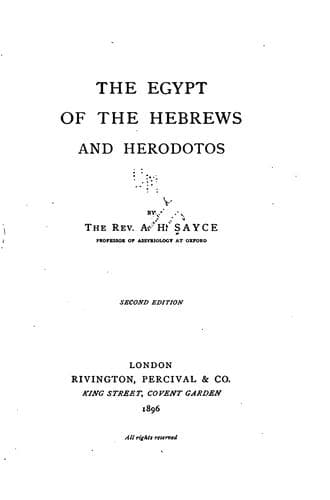
The Egypt of the Hebrews and HerodotosSayce, A. H. (Archibald Henry)
History
The Egypt of the Hebrews and Herodotos
Sayce, A. H. (Archibald Henry)
Egypt -- History, Ancient
One of the mythological tales discovered at Tel el-Amarna is the latter
portion of a story which described the creation of the first man, Adapa or
Adama, and the introduction of death into the world. Adapa had broken the
wings of the south wind, and was accordingly ordered to appear before Anu,
the lord of the sky. There he refused to touch the food and water of
“death” that were offered him, and when subsequently the heart of Anu was
“softened” towards him, he refused also the food and water of “life.”
Whereupon “Anu looked upon him and raised his voice in lamentation: ‘O
Adapa, wherefore eatest thou not? wherefore drinkest thou not? The gift of
life cannot now be thine.’ ”
The beginning of the story has been in the British Museum many years. It
is a fragment of a copy of the myth which was made for the library of
Nineveh some eight centuries after the rest of the story, which has now
been disinterred on the banks of the Nile, had been buried under the ruins
of Khu-n-Aten’s city. I copied it nearly twenty years ago, but had to wait
for the discovery of the tablets of Tel el-Amarna before ascertaining its
true meaning and significance. Nineveh and Tel el-Amarna had to unite in
the restoration of the old Babylonian myth.
Canaan was the country in which the two streams of Babylonian and Egyptian
culture met together, and we now know that Canaan was the centre of that
literary activity which the Tel el-Amarna tablets have revealed to us.
Canaan, in the age of the eighteenth dynasty, was emphatically the land of
scribes and letter-writers. If libraries existed anywhere in Western Asia,
they would surely have done so in the cities of Canaan.
One of these cities, Kirjath-Sepher, or “Book-town,” is mentioned in the
Old Testament. It was also called Kirjath-Sannah, or “City of
Instruction,” doubtless from the school which was attached to its library.
The site of it is unfortunately lost; should it ever be recovered, we may
expect to find beneath it literary treasures similar to those which the
mounds of Assyria and Babylonia have yielded. Perhaps some day the papyri
of Egypt will tell us where exactly to look for it.
A reference to it has already been met with. In the time of Ramses II., an
Egyptian scribe composed an ironical account of the adventures of a
military officer in Palestine. The officer in question was called a Mohar,
a word borrowed from the Babylonians, in whose language it signified “an
envoy.”
Public-domain text, read in full here on John Shaqi.
Reviews
Reviews
No reviews yet
Be the first to share your thoughts on this work.
Join the Discussion
Join the discussion
Sign in to leave a comment or review.
Sign InorCreate an account