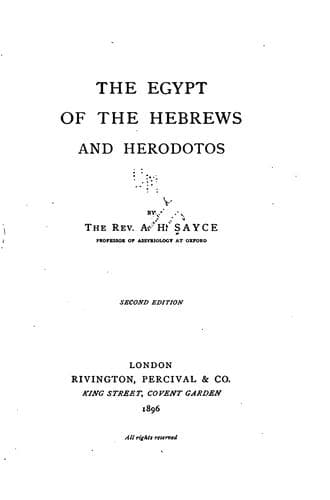
The Egypt of the Hebrews and Herodotos — John Shaqi
The Egypt of the Hebrews and HerodotosSayce, A. H. (Archibald Henry)
History
The Egypt of the Hebrews and Herodotos
Sayce, A. H. (Archibald Henry)
Egypt -- History, Ancient
_shirwâl_.
The pupil, therefore, who wished to learn the cuneiform syllabary at all
thoroughly was compelled to know something of the old Sumerian language of
Chaldæa. It was far more necessary in his case than a knowledge of Latin
would be in our own. Moreover, it was necessary for him to learn the
various forms which the same cuneiform character assumed in different
countries or at different periods in the same country. These various forms
were very numerous, and they often differed more than black letter differs
from ordinary modern type.
The fact, then, that the cuneiform syllabary was studied and used from the
banks of the Euphrates to those of the Nile, brings with it the further
fact that throughout this area there must have been numerous schools and
teachers. Time and persevering labour were needed for its acquisition,
while a knowledge of the Babylonian language which accompanied its study
could not have been obtained without the help of teachers. It is
accordingly a matter of no small astonishment that the letters received at
the Egyptian foreign office were written, not only by professional
scribes, but also by officials and soldiers.
Naturally the study of the foreign syllabary and language was facilitated
in every possible way. In his excavations at Tel el-Amarna, Professor
Flinders Petrie has discovered fragments of lists of cuneiform characters,
as well as of comparative dictionaries of Semitic Babylonian and Sumerian.
Moreover, a Babylonian mythological text has been found, in which the
words have been divided from one another by dots of red paint, in order to
assist the learner in making his way through the legend.
This mythological text is not the only one which has been met with among
the tablets of Tel el-Amarna. The existence of such texts is a proof that
the literature of Babylonia, as well as its language and script, was
carried to the West. From very remote times public libraries, consisting
for the most part of clay-books, were to be found in the Babylonian and
Assyrian cities, and when Babylonian culture made its way to the West,
similar libraries must have sprung up there also. The revelations made to
us by the tablets of Tel el-Amarna show that these libraries, like those
of Babylonia, were stocked with books written upon clay, many of which
contained copies of Babylonian legends and myths.
Public-domain text, read in full here on John Shaqi.
Reviews
Reviews
No reviews yet
Be the first to share your thoughts on this work.
Join the Discussion
Join the discussion
Sign in to leave a comment or review.
Sign InorCreate an account