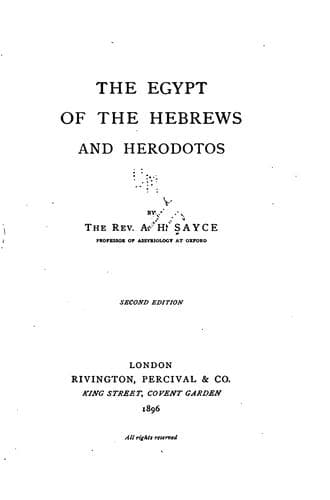
The Egypt of the Hebrews and Herodotos — John Shaqi
The Egypt of the Hebrews and HerodotosSayce, A. H. (Archibald Henry)
History
The Egypt of the Hebrews and Herodotos
Sayce, A. H. (Archibald Henry)
Egypt -- History, Ancient
The Egypt of the Middle Empire was divided among a number of great
princes, who had received their power and property by inheritance, and
resembled the great lords of the feudal age. The Pharaoh at first was
little more than the chief among his peers. But when the sceptre passed
into the vigorous hands of the kings of the twelfth dynasty, the influence
and authority of the feudal princes was more and more encroached upon. A
firm government at home and successful campaigns abroad restored the
supreme rule of the Pharaoh and made him, perhaps more than had ever been
the case before, a divinely-instituted autocrat.
The wars of the twelfth dynasty extended the Egyptian domination far to
the south. The military organisation of the Middle Empire was indeed its
most striking point of contrast to the Old Empire. The Egypt of the first
six dynasties had been self-contained and pacific. A few raids were made
from time to time against the negroes south of the First Cataract, but
only for the sake of obtaining slaves. The idea of extending Egyptian
power beyond the natural boundaries of Egypt has as yet never presented
itself. The Pharaohs of the Old Empire did not need an army, and
accordingly did not possess one. But with the Middle Empire all this was
changed. Egypt ceases to be isolated: its history will be henceforth part
of the history of the world. Foreign wars, however, and the organisation
of a strong government at home, did not absorb the whole energies of the
court. Temples and obelisks were erected, art was patronised, and the
creation of the Fayyûm, whereby a large tract of fertile land was won for
Egypt, not only proved the high engineering skill of the age of the
twelfth dynasty, but constituted a solid claim for gratitude to its
creator, Amon-em-hat III., on the part of all succeeding generations.
The thirteenth dynasty followed in the footsteps of its predecessor. We
possess the names of more than one hundred and fifty kings who belonged to
it, and their monuments were scattered from one end of Egypt to the other.
The fourteenth dynasty ended in disaster. Egypt was invaded by Asiatic
hordes, and the line of native Pharaohs was for a time extinct.
The invaders were called by Manetho, the Egyptian historian, the Hyksos or
Shepherd Princes: on the monuments they are known as the Aamu or
“Asiatics.” At first, we are told, their progress was marked by massacre
and destruction. The temples were profaned and overthrown, the cities
burned with fire. But after a while the higher culture of the conquered
people overcame the conquerors. A king arose among the invaders who soon
adopted the prerogatives and state of the Pharaohs. The fifteenth,
sixteenth, and seventeenth dynasties were Hyksos.
Public-domain text, read in full here on John Shaqi.
Reviews
Reviews
No reviews yet
Be the first to share your thoughts on this work.
Join the Discussion
Join the discussion
Sign in to leave a comment or review.
Sign InorCreate an account