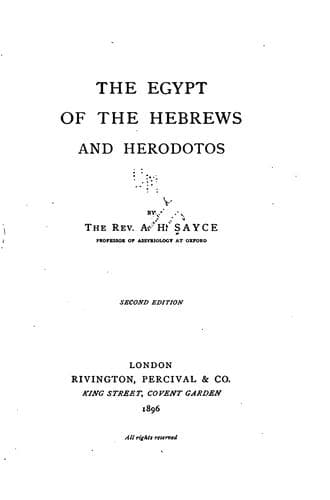
The Egypt of the Hebrews and HerodotosSayce, A. H. (Archibald Henry)
History
The Egypt of the Hebrews and Herodotos
Sayce, A. H. (Archibald Henry)
Egypt -- History, Ancient
From Coptic Christianity, just preparing to confront twelve centuries of
Mohammedan persecution, we must now turn back to Pagan Greece. The Persian
wars have breathed a new life into Greece and its colonies, and given them
a feeling of unity such as they never possessed before. Athens has taken
its place as leader not only in art and literature, but also in war, and
under the shelter of her name the Ionians of Asia Minor have ventured to
defy their Persian lord, and the Ionic dialect has ceased to be an object
of contempt. The Greek, always restless and curious to see and hear “some
new thing,” is now beginning to indulge his tastes at leisure, and to
visit as a tourist the foreign shores of the Mediterranean. Art has leaped
at a single bound to its perfection in the sculptures of Pheidias; poetry
has become divine in the tragedies of Æschylus and Sophocles, and history
is preparing to take part in the general development. The modern world of
Europe is already born.
The founder of literary history—of history, that is to say, which aims at
literary form and interest—was Herodotos of Halikarnassos. If Greek
tradition may be trusted, his uncle had been put to death by Lygdamis, the
despot of the city, and the subsequent expulsion of the tyrant was in some
measure due to the political zeal of the future historian. Herodotos was
wealthy and well educated, as fond of travel as the majority of his
countrymen, and not behind them in curiosity and vanity. He had cultivated
the literary dialect of Ionia, perhaps during his stay in Samos, and had
made good use there of the library of Polykratês, the friend and
correspondent of Amasis. What other libraries he may have consulted we do
not know, but his history shows that he had a considerable acquaintance
with the works of his predecessors, whom he desired to eclipse and
supersede. Hekatæus of Miletus, who had travelled in Egypt as far south as
Thebes, if not Assuan, and had written a full account of the country, its
people and its history, Xanthus, the Lydian, who had compiled the annals
of his native land, beside numberless other authors, historians and
geographers, poets and dramatists, philosophers and physicists, had been
made to contribute to his work. Now and again he refers to the older
historians when he wishes to correct or contradict them; more frequently
he silently incorporates their statements and words without mentioning
them by name. It was thus, we are told by Porphyry, that he “stole” the
accounts given by Hekatæus of the crocodile, the hippopotamus and the
phœnix, and the incorrectness of his description of that marvellous bird,
which, like Hekatæus, he likens to an eagle, proves that the charge is
correct. Reviewers did not exist in his days, nor were marks of quotation
or even footnotes as yet invented, and Herodotos might therefore plead
that, although he quoted freely without acknowledgment, he was not in any
real sense a plagiarist. He only acted like other Greek writers of his
Public-domain text, read in full here on John Shaqi.
Reviews
Reviews
No reviews yet
Be the first to share your thoughts on this work.
Elsewhere in the archive
Join the Discussion
Join the discussion
Sign in to leave a comment or review.
Sign InorCreate an account