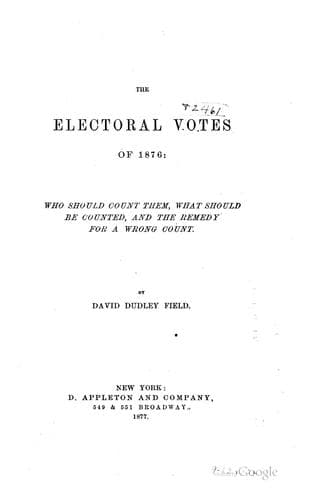
The Electoral Votes of 1876: Who Should Count Them, What Should Be Counted, and the Remedy for a Wrong CountField, David Dudley
History
The Electoral Votes of 1876: Who Should Count Them, What Should Be Counted, and the Remedy for a Wrong Count
Field, David Dudley
Presidents -- United States -- Election -- 1876
The sole object of all the machinery of elections, the ballots, the
ballot-boxes, the canvassers and supervisors of elections, the returns
and the returning boards, is, to ascertain the will of the people.
Nobody supposes that that will is ascertained to a certainty. An
approximation only is possible under our present system. To say
nothing of the exclusion of women from an expression of their will, a
portion only--though it may be a large portion--of the men express
theirs. The sick, the infirm, the absent, say nothing. The
registration is always in excess of the vote, and the number of voters
falls short of the registration. The reason is patent: many voters are
absent at the time of registration, or are otherwise unable or
unmindful to register; and when the time of voting arrives many of
those who are registered are absent or prevented from attendance. The
registration may generally be had on any one of several days, while
the voting is to be done on one day. The machinery is imperfect and
clumsy at best; but that is not a reason for making it worse, or
depriving ourselves of the advantages which it yields, notwithstanding
its imperfections. The nearest approach to absolute justice that we
can now hope to make is to _take the votes_ of all the voters who
offer themselves, and _count the votes that are taken_. Every scheme
of counting out legal votes cast, or counting in votes not cast, must
result in confusion, uncertainty, and fraud. No matter how specious
the argument may be, it will always mislead, for the reason that it
must in its nature substitute conjecture for fact. The vote must, of
course, be legal, it must be intelligible; but such a vote when
offered must be taken, and when taken counted.
The throwing out of all the votes of certain districts is but another
mode of accomplishing the same result as would be effected by the
rejection and addition of votes in the cases supposed: for, if there
be 10,000 voters in the district, and 5,000 only vote, it can make no
difference whether the 5,000 be rejected, or be allowed to remain and
the same number be added to the other side.
Public-domain text, read in full here on John Shaqi.
Reviews
Reviews
No reviews yet
Be the first to share your thoughts on this work.
Join the Discussion
Join the discussion
Sign in to leave a comment or review.
Sign InorCreate an account