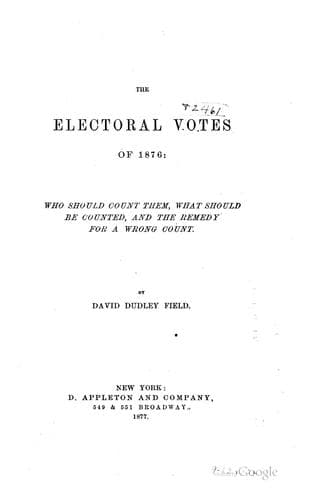
The Electoral Votes of 1876: Who Should Count Them, What Should Be Counted, and the Remedy for a Wrong CountField, David Dudley
History
The Electoral Votes of 1876: Who Should Count Them, What Should Be Counted, and the Remedy for a Wrong Count
Field, David Dudley
Presidents -- United States -- Election -- 1876
Whatever may be the law of a State in respect to the choice of its own
officers, it seems most reasonable to hold that, under that common
Constitution which governs and provides for all the States alike, when
the only legitimate inquiry is whom has a particular _State_
appointed, in the manner directed by its Legislature, and the
Legislature has directed the appointment to be made by a general
election, that is, by the votes of all qualified persons, the only
valid office of a returning board must be to ascertain and declare how
the State has actually voted, not how it might or would have voted
under other circumstances, or, in other words, what is the number of
legal votes actually cast; not how many have been unduly influenced,
or how many other votes would have been cast in a different state of
affairs. I use the expression undue influence, as more comprehensive
than riot, bribery, or intimidation, and including other forms of
improper influence, such as that of capital over labor. The question
should be put in a general form to be correctly answered, because
there is nothing in intimidation by violence which would make it a
good cause for exclusion, more than that other kind of intimidation,
which is social or financial. If, in ascertaining the state of the
vote, it be lawful to inquire whether certain voters were frightened
by a rifle-club to stay away from the polls, or to vote as the club
dictated, it must also be lawful to inquire whether the same number of
voters were induced to vote or not to vote by fear that their
discounts might be lessened at the village bank, or their employment
discontinued at the neighboring factory. I state the proposition,
therefore, as one covering all kinds of undue influence. I refrain,
however, from going into the question whether this influence was or
was not exerted, for I am inquiring into the law as applicable to
certain alleged facts, leaving the truth of the allegations to be
dealt with by others.
Public-domain text, read in full here on John Shaqi.
Reviews
Reviews
No reviews yet
Be the first to share your thoughts on this work.
Join the Discussion
Join the discussion
Sign in to leave a comment or review.
Sign InorCreate an account