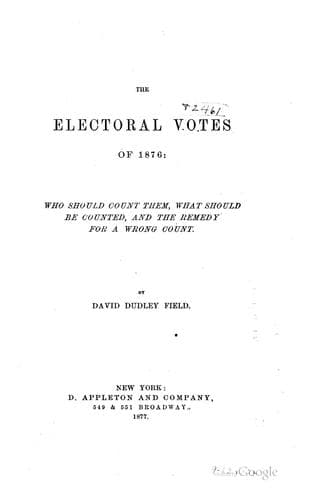
The Electoral Votes of 1876: Who Should Count Them, What Should Be Counted, and the Remedy for a Wrong CountField, David Dudley
History
The Electoral Votes of 1876: Who Should Count Them, What Should Be Counted, and the Remedy for a Wrong Count
Field, David Dudley
Presidents -- United States -- Election -- 1876
Not to go abroad, however, for illustrations, let us suppose that the
General Court convened in the State-House at Boston were to depute the
State of New York or the State of Virginia to appoint electors for the
State of Massachusetts, no man would be wild enough to pronounce such
a deputation valid. It should seem to be certain, for a reason hardly
less satisfactory, that the Legislature of Massachusetts could not
authorize the Mayor of Boston or the town council of Worcester to
appoint her electors; and, if that be so, and the rule is to prevail
that, in law, what cannot be done directly cannot be done indirectly,
it should follow that the State could not delegate to any other agency
the power of appointment. If a body called a returning board be so
constituted as that, in certain contingencies, it may depart from the
inquiry what votes have been cast, and cast the votes itself, or by
_any sort of contrivance_ do the same thing under a different name, or
by a roundabout process, it is, to that extent, an unlawful body under
the Federal Constitution. Assuming, then, that a returning board has
among its functions that of rejecting the votes in particular
districts, for the reason either that they were affected by undue
influence, or that other voters were led by like influence to refrain
from voting, can such a function be valid under the Constitution of
the United States? There is no question were of throwing out
particular votes for vices inherent in themselves, such as that they
were illegible, or were cast by disqualified persons, and the like;
but the question is of rejecting the votes of a certain number--say a
thousand voters--either because they were unduly influenced, or
because another thousand, who might have voted, were, by undue
influences, prevented from voting at all.
Public-domain text, read in full here on John Shaqi.
Reviews
Reviews
No reviews yet
Be the first to share your thoughts on this work.
Join the Discussion
Join the discussion
Sign in to leave a comment or review.
Sign InorCreate an account