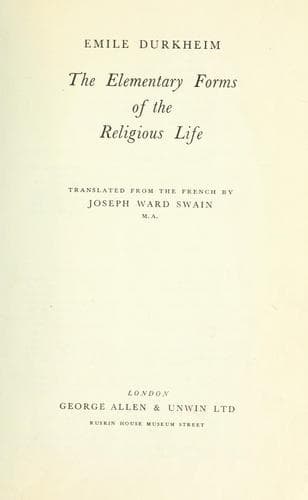
The Elementary Forms of the Religious LifeDurkheim, Émile
Religion
The Elementary Forms of the Religious Life
Durkheim, Émile
Cults; Religion; Religion -- Philosophy; Rites and ceremonies; Totemism
This difference is due to the superiority of their social economy. From
the moment when these tribes were observed for the first time, the
social groups were strongly attached to the soil, and consequently
better able to resist the decentralizing forces which assailed them. At
the same time, the society had too keen a sentiment of its unity to
remain unconscious of itself and of the parts out of which it was
composed. The example of America thus enables us to explain even better
the organization at the base of the clans. We would take a mistaken
view, if we judged this only on the present conditions in Australia. In
fact, it is in a state of change and dissolution there, which is not at
all normal; it is much rather the product of a degeneration which we
see, due both to the natural decay of time and the disorganizing effect
of the whites. To be sure, it is hardly probable that the Australian
clans ever had the dimensions and solid structure of the American ones.
But there must have been a time when the distance between them was less
considerable than it is to-day, for the American societies would never
have succeeded in making so solid a structure if the clans had always
been of so fluid and inconsistent a nature.
This greater stability has even enabled the archaic system of phratries
to maintain itself in America with a clearness and a relief no longer to
be found in Australia. We have just seen that in the latter continent
the phratry is everywhere in a state of decadence; very frequently it is
nothing more than an anonymous group; when it has a name, this is either
no longer understood, or in any case, it cannot mean a great deal to the
native, since it is borrowed from a foreign language, or from one no
longer spoken. Thus we have been able to infer the existence of totems
for phratries only from a few survivals, which, for the most part, are
so slightly marked that they have escaped the attention of many
observers. In certain parts of America, on the contrary, this
institution has retained its primitive importance. The tribes of the
North-west coast, the Tlinkit and the Haida especially, have now
attained a relatively advanced civilization; yet they are divided into
two phratries which are subdivided into a certain number of clans: the
phratries of the Crow and the Wolf among the Tlinkit,[264] of the Eagle
and the Crow among the Haida.[265] And this division is not merely
nominal; it corresponds to an ever-existing state of tribal customs and
is deeply marked with the tribal life. The moral distance separating the
clans is very slight in comparison with that separating the
phratries.[266] The name of each is not a word whose sense is forgotten
or only vaguely known; it is a totem in the full sense of the term; they
have all its essential attributes, such as will be described below.[267]
Consequently, upon this point also, American tribes must not be
neglected, for we can study the totems of phratries directly there,
Public-domain text, read in full here on John Shaqi.
Reviews
Reviews
No reviews yet
Be the first to share your thoughts on this work.
Elsewhere in the archive
Join the Discussion
Join the discussion
Sign in to leave a comment or review.
Sign InorCreate an account