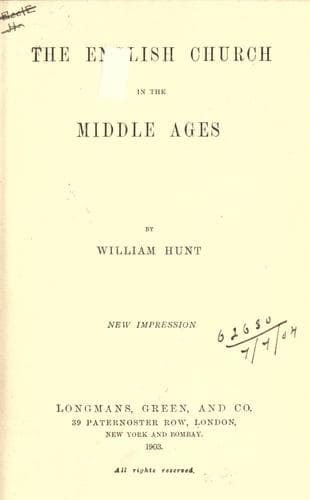
The English Church in the Middle Ages — John Shaqi
The English Church in the Middle AgesHunt, William
History
The English Church in the Middle Ages
Hunt, William
Church history -- Middle Ages, 600-1500; Great Britain -- Church history
While, however, the Church had this strongly national character, it was in
obedience to the Roman see. Archbishops did not consecrate bishops until
they had received the pall from the Pope. At first the pall was sent to
them, but by the beginning of the eighth century they were expected to
fetch it, and this soon became an invariable rule, which strengthened the
idea of the dependence of the Church, and afforded opportunities for
extortion and aggression. No legates landed here from the time of Theodore
until two were sent over by Hadrian in 786. Hadrian's legates held synods
in both the two provinces, and published a body of canons, which the kings
and their thegns, the archbishops, bishops, and all who attended pledged
themselves to obey. By one of these the payment of tithes was, we have
seen, made part of the law of the land. Another illustrates the influence
of the Church on the conception of kingship. Although the crown invested
the king with personal pre-eminence, there was as yet no idea of the
sanctity conferred by the religious rite of anointing, which had taken the
place of the old Teutonic ceremonies. It was now ordained that no one of
illegitimate birth should be chosen king, for none such might enter the
priesthood, and that any one who plotted the king's death should be held
guilty of the sin of Judas, because the king was the Lord's Anointed. The
Church, however, was not to fall into the snare of adulation; bishops were
to speak the word of God to kings without fear, and kings were to obey
them as those who held the keys of Heaven.
Public-domain text, read in full here on John Shaqi.
Reviews
Reviews
No reviews yet
Be the first to share your thoughts on this work.
Join the Discussion
Join the discussion
Sign in to leave a comment or review.
Sign InorCreate an account