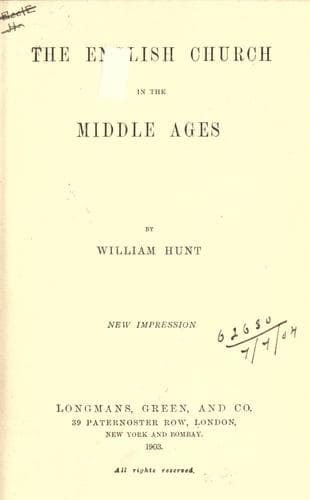
The English Church in the Middle AgesHunt, William
History
The English Church in the Middle Ages
Hunt, William
Church history -- Middle Ages, 600-1500; Great Britain -- Church history
For the next three hundred years the Church was almost wholly free from
the direct control of legatine visits. Appeals to the judgment of the
Roman see had for the first time been made by Wilfrith, and the Church, as
we have seen, cordially upheld the resistance offered by kings and nobles
to the Pope's attempts to set aside the decision of national councils.
The compromise that was at last effected was not a papal triumph.
Nevertheless the authority of the Pope was generally acknowledged, and the
most powerful kings thought it needful to obtain the sanction of Rome for
ecclesiastical changes, such as the erection and suppression of the
Mercian archbishopric. Moreover, Englishmen venerated Rome as the
Apostolic See and the mother of Catholic Christendom, and made frequent
pilgrimages thither. First, ecclesiastics journeyed to Rome either for
purposes of business or devotion. Then, towards the end of the seventh
century, Ceadwalla, a West Saxon king, went thither to receive baptism,
praying that he might die as soon as he was cleansed from his sins, and
his prayer was granted. His example was followed by other kings, and among
them by his successor, Ini. Crowds of persons of both sexes and every
condition now went on pilgrimage. In Offa's time there were special
buildings at Rome called the "Saxon School" for the accommodation of
English pilgrims, and the Mercian king obtained a promise from Charles the
Great that they should be free of toll in passing through his dominions.
[Sidenote: The Church and Western Christendom.]
The missionary labours of Willibrord, of Winfrith or Boniface, and other
Englishmen brought our Church into close relationship with other Churches
of Western Europe, for a constant correspondence was kept up between the
missionaries and their brethren at home. The connexion between the English
and Frankish Churches was strengthened by the residence of Alcuin at the
court of Charles the Great, and by the desire of Offa to establish
friendly relations with the Frankish monarch. Alcuin obtained a letter
from the kings and bishops of England, agreeing with the condemnation
which Charles pronounced against the decree of the Second Council of Nice,
re-establishing the worship of images in the Eastern Church, and English
bishops attended the council Charles held at Frankfort, where the action
of the Greeks and the opinions of certain Adoptionist heretics were
condemned. At the close of the eighth century our Church was highly
esteemed throughout Western Christendom, and this was due both to the
noble work accomplished by English missionaries and to the literary
greatness of Northumbria, the home of Alcuin.
CHAPTER III.
_RUIN AND REVIVAL._
Public-domain text, read in full here on John Shaqi.
Reviews
Reviews
No reviews yet
Be the first to share your thoughts on this work.
Join the Discussion
Join the discussion
Sign in to leave a comment or review.
Sign InorCreate an account