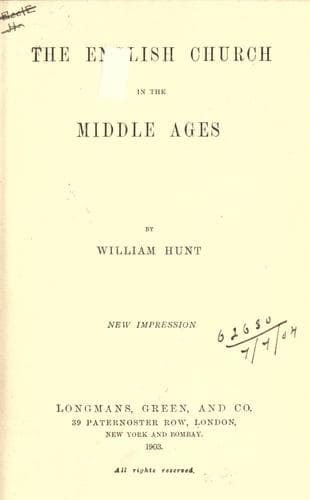
The English Church in the Middle AgesHunt, William
History
The English Church in the Middle Ages
Hunt, William
Church history -- Middle Ages, 600-1500; Great Britain -- Church history
side Humber who could understand their rituals in English, or translate a
letter from Latin into English, and not many beyond Humber."
There was little difference between the priest and his people; the clergy
shared largely in the national habit of excessive drinking, and many
priests were married. Among the laity morality was at a low ebb; the
marriage tie was lightly regarded, and there was a general return to the
laxity and vices of paganism. Heathen customs gathered fresh strength, and
women dealt in enchantments and called up ghostly forms. Alfred determined
to save his people from barbarism; he set himself to be their teacher, and
sought for others to help in his work. From the English part of Mercia,
where learning was more advanced than in Wessex, he brought Plegmund, who
was afterwards chosen archbishop, and other clerks; Bishop Asser came to
him from Wales; from beyond sea, Grimbold, a monk of St. Bertin's, and
John from the old Saxon land. He desired that every youth whose parents
could afford it should be sent to school till he could read English well,
and those who hoped for promotion till they could read Latin. Accordingly,
he set up a school for young nobles in his palace, and made education the
prominent feature in a monastery he founded at Athelney. He translated
into English such books as he thought most needful for his people to read,
and probably began the national record called the "Anglo-Saxon Chronicle"
in the form we now have it. The care with which he fostered vernacular
literature led to the use of English in religious teaching, and to the
composition of books of homilies in that language. His code of laws,
which consists of a selection from earlier laws and the decrees of synods,
contains many ecclesiastical provisions; it treats religion as the
foundation of civil law, and begins with the Ten Commandments and an
account of the precepts of Moses. As the over-lord of Guthorm, he joined
him in publishing a special code for the people of East Anglia, by which
apostasy was declared a crime, negligent priests were to be fined, the
payment of Peter's pence was commanded, and the practice of heathen rites
was forbidden. Alfred brought his kingdom into renewed relations with
Rome, for year after year he sent thither alms from himself and his
people, probably re-establishing the payment of Peter's pence, which had
been interrupted during the period of invasion.
[Sidenote: Character of the Church in the tenth century.]
Public-domain text, read in full here on John Shaqi.
Reviews
Reviews
No reviews yet
Be the first to share your thoughts on this work.
Join the Discussion
Join the discussion
Sign in to leave a comment or review.
Sign InorCreate an account