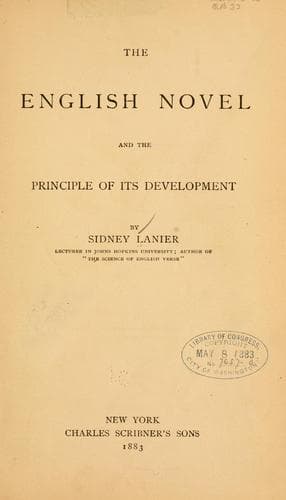
The English Novel and the Principle of its DevelopmentLanier, Sidney
History
The English Novel and the Principle of its Development
Lanier, Sidney
English fiction -- History and criticism
Nor need I dwell upon Scott's novels, which stretch from 1814 to 1831,
which we have all known from our childhood as among the most hale and
strengthening waters in which the young soul ever bathed. They discuss
no moral problems, they place us in no relation towards our fellow
that can be called moral at all, they belong to that part of us which
is youthful, undebating, wholly unmoral--though not immoral--they are
simply always young, always healthy, always miraculous. And I can only
give now a hasty additional flavor of these Scott days by reminding
you of the bare names of Thomas Hope, Lockhart, Theodore Hook, Mrs.
Trollope, Mrs. Gore and Miss Mitford. It seems always comfortable in
a confusion of this kind to have some easily-remembered formula which
may present us a considerable number of important facts in portable
shape. Now the special group of writers which I wish to contrast with
the classic group, consisting of Dickens, Thackeray, Tennyson, Mrs.
Browning, Charlotte Bronte, and George Eliot, are at work between 1837
and 1857; and for the purpose of giving you a convenient skeleton or
set of vertebræ, containing some main facts affecting the English
novel of the nineteenth century, I have arranged this simple table
which proceeds by steps of ten years up to the period mentioned.
For example: since these all end in seven; beginning with the year
1807, it seems easy to remember that that is the date of Charles and
Mary Lamb's _Tales from Shakspeare_; skipping ten years to 1817, in
this year _Blackwood's Magazine_ is established, a momentous event in
fiction generally and particularly as to George Eliot's; advancing ten
years, in 1827, Bulwer's _Pelham_ appears, and also the very
stimulating _Specimens of German Romance_, which Thomas Carlyle
edited; in 1837 the adorable _Pickwick_ strolls into fiction; in 1847
Thackeray prints _Vanity Fair_, Charlotte Bronte gives us _Jane Eyre_,
and Tennyson _The Princess_; and finally, in 1857, as we have seen,
George Eliot's _Scenes of Clerical Life_ are printed, while so closely
upon it in the previous year as to be fairly considered contemporary,
comes Mrs. Browning's _Aurora Leigh_.
Public-domain text, read in full here on John Shaqi.
Reviews
Reviews
No reviews yet
Be the first to share your thoughts on this work.
Elsewhere in the archive
Join the Discussion
Join the discussion
Sign in to leave a comment or review.
Sign InorCreate an account