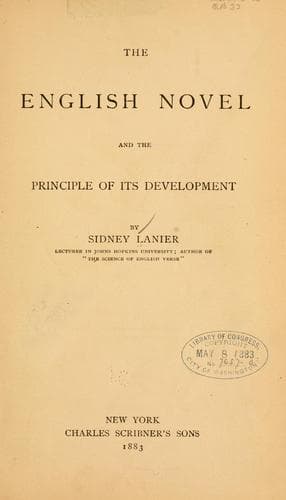
The English Novel and the Principle of its DevelopmentLanier, Sidney
History
The English Novel and the Principle of its Development
Lanier, Sidney
English fiction -- History and criticism
Now I do not know any more vivid way of bringing before you the
precise work which English fiction is doing at the time George Eliot
sets in, than by asking you to run your eye along the last four dates
here given, 1827, 1837, 1847, 1857. Here, in 1827, advances a
well-dressed man, bows a fine bow, and falls to preaching his gospel:
"My friends, under whatever circumstances a man may be placed, he has
it always in his power to be a gentleman;" and Bulwer's gentleman is
always given as a very manful and Christian being. I am well aware of
the modern tendency to disparage Bulwer, as a slight creature; but
with the fresh recollection of his books as they fell upon my own
boyhood, I cannot recall a single one which did not leave, as a last
residuum, the picture in some sort of the chivalrous gentleman
impressed upon my heart. I cheerfully admit that he sometimes came
dangerously near snobbery, and that he was uncivil and undignified and
many other bad things in the _New Timon_ and the Tennyson quarrel; and
I concede that it must be difficult for us--you and me, who are so
superior and who have no faults of our own--to look upon these
failings with patience; and yet I cannot help remembering that every
novel of Bulwer's is skilfully written and entertaining, and that
there is not an ignoble thought or impure stimulus in the whole range
of his works.
But, advancing, here, in 1837, comes on a preacher who takes up the
slums and raggedest miseries of London and plumps them boldly down in
the parlors of high life; and, like the boy in the fairy tale whose
fiddle compelled every hearer to dance in spite of himself, presently
has a great train of people following him, ready to do his bidding in
earnestly reforming the prisons, the schools, the workhouses, and the
like, what time the entire train are roaring with the genialest of
laughter at the comical and grotesque figures which this peculiar
Dickens has fished up out of the London mud.
But again: here, in 1847, we have Thackeray exposing shame and high
vulgarity and minute wickedness, while Charlotte Bronte and Tennyson,
with the widest difference in method, are for the first time
expounding the doctrine of co-equal sovereignty as between man and
woman, and bringing up the historic conception of the personality of
woman to a plane in all respects level with, though properly
differentiated from, that of man. It is curious to see the depth of
Charlotte Bronte's adoration for Thackeray, the intense, high-pitched
woman for the somewhat slack, and as I always think, somewhat
low-pitched satirist; and perhaps the essential utterance of
Thackeray, as well as the fervent tone which I beg you to observe is
now being acquired by the English novel, the awful consciousness of
its power and its mission, may be very sufficiently gathered from some
of Charlotte Bronte's words about Thackeray which occur in the Preface
to the second edition of her _Jane Eyre_:
Public-domain text, read in full here on John Shaqi.
Reviews
Reviews
No reviews yet
Be the first to share your thoughts on this work.
Elsewhere in the archive
Join the Discussion
Join the discussion
Sign in to leave a comment or review.
Sign InorCreate an account