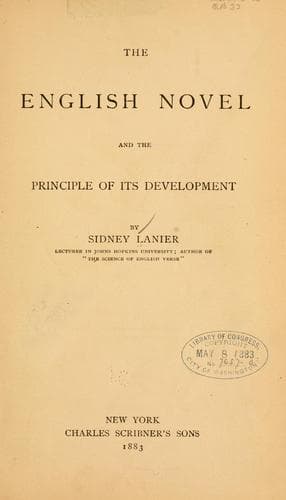
The English Novel and the Principle of its DevelopmentLanier, Sidney
History
The English Novel and the Principle of its Development
Lanier, Sidney
English fiction -- History and criticism
"There is a man in our own days whose words are not framed to
tickle delicate ears; who, to my thinking, comes before the great
ones of society much as the son of Imlah came before the throned
kings of Judah and Israel; and who speaks truth as deep, with a
power as prophet-like and as vital--a mien as dauntless and as
daring. Is the satirist of _Vanity Fair_ admired in high places?
I cannot tell; but I think if some of those amongst whom he hurls
the Greek-fire of his sarcasm, and over whom he flashes the
levin-brand of his denunciation, were to take his warnings in
time, they or their seed might yet escape a fatal Ramoth-Gilead.
"Why have I alluded to this man? I have alluded to him, reader,
because I think I see in him an intellect profounder and more
unique than his contemporaries have yet recognized; because I
regard him as the first social regenerator of the day: as the
very master of that working corps who would restore to rectitude
the warped system of things."
Now, into this field of beneficent activity which _The Novel_ has
created, comes in 1857 George Eliot: comes with no more noise than
that of a snow-flake falling on snow, yet--as I have said, and as I
wish now to show with some detail--comes as an epoch-maker, both by
virtue of the peculiar mission she undertakes and of the method in
which she carries it out.
What then is that peculiar mission?
In the very first of these stories, _Amos Barton_, she announces it
quite explicitly, though it cannot be supposed at all consciously.
Before quoting the passage, in order that you may at once take the
full significance of it, let me remind you of a certain old and
grievous situation as between genius and the commonplace person. For a
long time every most pious thinker must have found one of the
mysteries most trying to his faith to be the strange and apparently
unjustifiable partiality of God's spiritual gifts as between man and
man.
For example, we have a genius (say) once in a hundred years; but this
hundred years represents three generations of the whole world; that is
to say, here are three thousand million commonplace people to one
genius.
Now, with all the force of this really inconceivable numerical
majority, the cry arises, How monstrous! Here are three thousand
millions of people to eat, sleep, die, and rot into oblivion, and but
one man is to have such faculty as may conquer death, win fame, and
live beyond the worms!
Public-domain text, read in full here on John Shaqi.
Reviews
Reviews
No reviews yet
Be the first to share your thoughts on this work.
Elsewhere in the archive
Join the Discussion
Join the discussion
Sign in to leave a comment or review.
Sign InorCreate an account