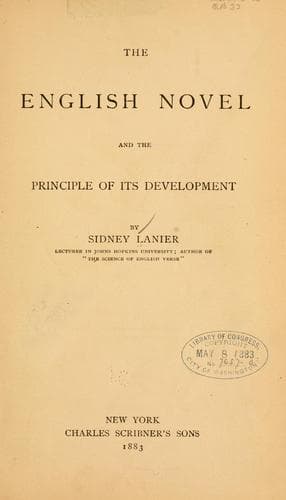
The English Novel and the Principle of its DevelopmentLanier, Sidney
History
The English Novel and the Principle of its Development
Lanier, Sidney
English fiction -- History and criticism
Now, no one feels this inequality so keenly as the great genius
himself. I find in Shakspeare, in Beethoven, in others, often an
outcrop of feeling which shows that the genius cringes under this load
of favoritism, as if he should cry in his lonesome moments, _Dear
Lord, why hast thou provided so much for me, and so little for yonder
multitude?_ In plain fact, it seems as if there was never such a
problem as this: what shall we do about these three thousand millions
of common men as against the one uncommon man, to save the goodness
of God from seeming like the blind caprice of a Roman Emperor!
It is precisely here that George Eliot comes to the rescue; and though
she does not solve the problem--no one expects to do that--at any rate
she seems to me to make it tolerable, and to take it out of that class
of questions which one shuts back for fear of nightmare and insanity.
Emerson has treated this matter partially and from a sort of
side-light. "But," he exclaims in the end of his essay on _The Uses of
Great Men_, "_great men_,--the word is injurious. Is there caste? Is
there fate? What becomes of the promise to virtue?... Why are the
masses, from the dawn of history down, food for knives and powder? The
idea dignifies a few leaders, ... and they make war and death sacred;
but what for the wretches whom they hire and kill? The cheapness of
man is everyday's tragedy." And more to this purport. But nothing
could be more unsatisfactory than Emerson's solution of the problem.
He unhesitatingly announces on one page that the wrong is to be
righted by giving every man a chance in the future, in (say) different
worlds; every man is to have his turn at being a genius; until "there
are no common men." But two pages farther on this elaborate scheme of
redress is completely swept away by the announcement that after all
the individual is nothing, the quality is what abides, and so falls
away in that singular delusion of his, that personality is to die away
into the first cause.
Public-domain text, read in full here on John Shaqi.
Reviews
Reviews
No reviews yet
Be the first to share your thoughts on this work.
Elsewhere in the archive
Join the Discussion
Join the discussion
Sign in to leave a comment or review.
Sign InorCreate an account