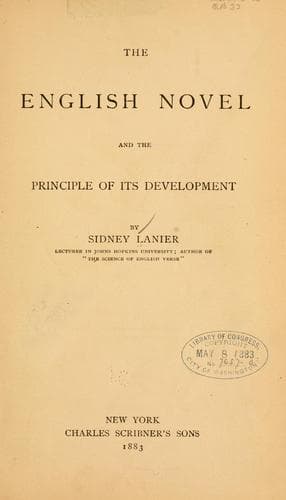
The English Novel and the Principle of its DevelopmentLanier, Sidney
History
The English Novel and the Principle of its Development
Lanier, Sidney
English fiction -- History and criticism
On the other hand, if you will permit me to quote a few pathetic words
which I find in Carlyle's _Reminiscences_, in the nature of a sigh and
aspiration, and breathed blessing all in one upon his wife and her
ministrations to him during that singular period of his life when he
suddenly left London and buried himself in his wild Scotch farm of
Craigenputtoch, I shall be able to show you how Carlyle, most
unconsciously, dreams toward a far more satisfactory end of this
matter than Emerson's, and then how George Eliot actually brings
Carlyle's dream to definite form, and at last partial fulfilment in
the very beginning of her work. Carlyle is speaking of the rugged
trials and apparent impossibilities of living at Craigenputtoch when
he and his Jeanie went there, and how bravely and quietly she faced
and overcame the poverty, the ugliness, the almost squalor, which was
their condition for a long time. "Poverty and mean obstruction
continued," he says, "to preside over it, but were transformed by
human valor of various sorts into a kind of victory and royalty.
Something of high and great dwelt in it, though nothing could be
smaller and lower than many of the details. How blessed might poor
mortals be in the straitest circumstances, if only their wisdom and
fidelity to Heaven and to one another were _adequately_ great! It
looks to me now like a kind of humble russet-coated _epic_, that seven
years' settlement at Craigenputtoch, very poor in this world's goods,
but not without an intrinsic dignity greater and more important than
then appeared; thanks very mainly to her, and her faculties and
magnanimities, without whom it had not been possible."
And now, let us hear the words in which George Eliot begins to preach
the "russet-coated epic" of everyday life and of commonplace people.
The Rev. Amos Barton, whose sad fortunes I have undertaken to
relate, was, you perceive, in no respect an ideal or exceptional
character; and perhaps I am doing a bold thing to bespeak your
sympathy on behalf of a man who was so very far from
remarkable,--a man whose virtues were not heroic, and who had no
undetected crime within his breast; who had not the slightest
mystery hanging about him, but was palpably and unmistakably
commonplace; who was not even in love, but had had that
complaint favorably many years ago. "An utterly uninteresting
character!" I think I hear a lady reader exclaim--Mrs.
Farthingale, for example, who prefers the ideal in fiction; to
whom tragedy means ermine tippets, adultery, and murder; and
comedy, the adventures of some personage who is quite a
"character."
Public-domain text, read in full here on John Shaqi.
Reviews
Reviews
No reviews yet
Be the first to share your thoughts on this work.
Elsewhere in the archive
Join the Discussion
Join the discussion
Sign in to leave a comment or review.
Sign InorCreate an account