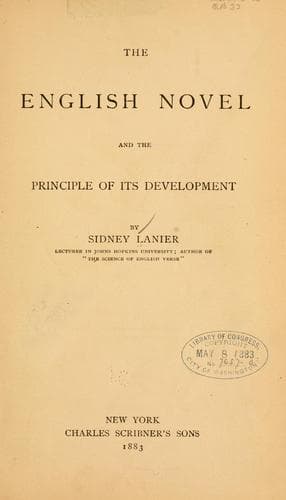
The English Novel and the Principle of its DevelopmentLanier, Sidney
History
The English Novel and the Principle of its Development
Lanier, Sidney
English fiction -- History and criticism
But, my dear madam, it is so very large a majority of your
fellow-countrymen that are of this insignificant stamp. At least
eighty out of a hundred of your adult male fellow-Britons
returned in the last census are neither extraordinarily wicked,
nor extraordinarily wise; their eyes are neither deep and liquid
with sentiment, nor sparkling with suppressed witticisms; they
have probably had no hair-breadth escapes or thrilling
adventures; their brains are certainly not pregnant with genius,
and their passions have not manifested themselves at all after
the fashion of a volcano. They are simply men of complexions more
or less muddy, whose conversation is more or less bald and
disjointed. Yet these commonplace people--many of them--bear a
conscience, and have felt the sublime prompting to do the painful
right; they have their unspoken sorrows and their sacred joys;
their hearts have perhaps gone out towards their first-born, and
they have mourned over the irreclaimable dead. Nay, is there not
a pathos in their very insignificance--in our comparison of their
dim and narrow existence with the glorious possibilities of that
human nature which they share.
Depend upon it, you would gain unspeakably if you would learn
with me to see some of the poetry and the pathos, the tragedy and
the comedy, lying in the experience of a human soul that looks
out through dull gray eyes, and that speaks in a voice of quite
ordinary tone. In that case, I should have no fear of your not
caring to know what further befell the Rev. Amos Barton, or of
your thinking the homely details I have to tell at all beneath
your attention. As it is, you can, if you please, decline to
pursue my story further; and you will easily find reading more to
your taste, since I learn from the newspapers that many
remarkable novels, full of striking situations, thrilling
incidents, and eloquent writing, have appeared only within the
last season.
Let us now pass on to _Adam Bede_, _The Mill on the Floss_, and the rest of
George Eliot's works in historic order, and see with what delicious fun,
what play of wit, what ever-abiding and depth-illuminating humor, what
creative genius, what manifold forms of living flesh and blood, George
Eliot preached the possibility of such moral greatness on the part of every
most commonplace man and woman as completely reduces to a level the
apparent inequality in the matter of genius, and so illustrated the
universal "russet-coated epic."
IX.
Public-domain text, read in full here on John Shaqi.
Reviews
Reviews
No reviews yet
Be the first to share your thoughts on this work.
Elsewhere in the archive
Join the Discussion
Join the discussion
Sign in to leave a comment or review.
Sign InorCreate an account