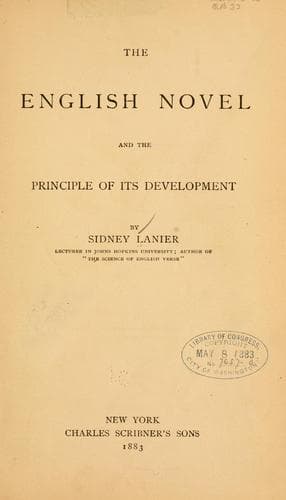
The English Novel and the Principle of its DevelopmentLanier, Sidney
History
The English Novel and the Principle of its Development
Lanier, Sidney
English fiction -- History and criticism
Before _Scenes from Clerical Life_ had ceased to run, in the latter
part of the year 1857, George Eliot had already begun a novel more
complete in form than any of the three tales which composed that
series. Early in 1858, she made a visit to the Continent, and it was
from Munich that a considerable portion of the MS. of her new book was
sent to her publisher, Mr. Blackwood. This was _Adam Bede_, which she
completed by the end of October, 1858.
It was brought out immediately in book form; George Eliot seemed
desirous of putting the public to a speedier test than could be
secured by running the story through successive numbers of the
magazine, as usual; although the enthusiastic editor declared himself
very willing to enrich the pages of _Blackwood's_ with it. It was
therefore printed in January, 1859.
I have already cited a letter from Marian Evans to Miss Henschel, in which
she mentions the only two matters of fact connected in the most shadowy way
as originals with the plot of _Adam Bede_. One of these is that in her
girlhood, she had met an aunt of hers about sixty years old, who had in
early life been herself a preacher. To this extent, and this only, is there
any original for our beautiful snow-drop--Dinah Morris, in _Silas Marner_.
Again, in the same letter, George Eliot mentions that this same aunt had
told her of once spending a night in prison to comfort a poor girl who had
murdered her own child, and that this incident lay in her mind for many
years, until it became the germ of _Adam Bede_.
These are certainly but shadowy connections; yet, probably, the
greatest works are built upon quite as filmy a relation to any actual
precedent facts. A rather pretty story is told of Mrs. Carlyle, which,
perhaps, very well illustrates this filmy relation. It is told that
one evening she gave to Dickens a subject for a novel which she had
indeed worked out up to the second volume, the whole subject
consisting of a weaving together of such insignificant observations as
any one must make of what goes on at houses across the street. For
example,--Mrs. Carlyle observed of a house nearly opposite them that
one day the blinds or curtains would be up or down; the next day a
figure in a given costume would appear at the window, or a cab would
drive, hastily or otherwise, to the door, a visitor would be admitted
or rejected, etc; such bits of circumstances she had managed to
connect with human characters in a subtle way which is said to have
given Dickens great delight. She never lived, however, to finish her
novel, thus begun.
Public-domain text, read in full here on John Shaqi.
Reviews
Reviews
No reviews yet
Be the first to share your thoughts on this work.
Elsewhere in the archive
Join the Discussion
Join the discussion
Sign in to leave a comment or review.
Sign InorCreate an account