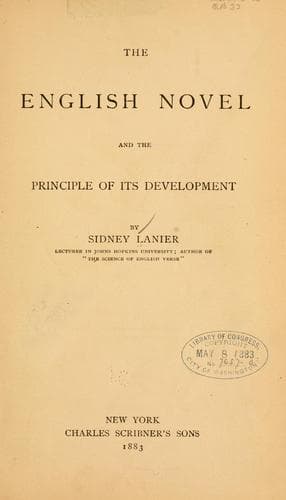
The English Novel and the Principle of its DevelopmentLanier, Sidney
History
The English Novel and the Principle of its Development
Lanier, Sidney
English fiction -- History and criticism
And here it seems profitable to contrast George Eliot's peculiar
endowment as shown in these first stories, with that of Thackeray.
Thackeray was accustomed to lament that "since the author of _Tom
Jones_ was buried, no writer of fiction among us has been permitted to
depict to his utmost powers a man.... Society will not tolerate the
natural in art." Under this yearning of Thackeray's after the supposed
freedom of Fielding's time, lie at once a short-coming of love, a
limitation of view and an actual fallacy of logic, which always kept
Thackeray's work below the highest, and which formed the chief reason
why I have been unable to place him here, along with Dickens and
George Eliot. This short-coming and limitation still exist in our
literature and criticism to such an extent that I can do no better
service than by asking you to examine them. And I think I can
illustrate the whole in the shortest manner by some considerations
drawn from that familiar wonder of our times, the daily newspaper.
Consider the printed matter which is brought daily to your breakfast
table. The theory of the daily paper is that it is the history of the
world for one day; and let me here at once connect this illustration
with the general argument by saying that Thackeray and his school,
when they speak of drawing a man as he is--of the natural, etc., in
art--would mean drawing a man as he appears in such a history as the
daily newspaper gives us. But let us test this history: let us
examine, for instance, the telegraphic column in the morning journal.
I have made a faithful transcript on the morning of this writing of
every item in the news summary, involving the moral relation of man
to man; the result is as follows: one item concerning the
assassination of the Czar; the recent war with the Boers in Africa;
the quarrel between Turkey and Greece; the rebellion in Armenia; the
trouble about Candahar; of a workman in a lumber-camp in Michigan, who
shot and killed his wife, twenty-two years old, yesterday; of the
confession of a man just taken from the West Virginia penitentiary, to
having murdered an old man in Michigan, three years ago; of the
suicide of Mrs. Scott at Williamstown, Mississippi; of the killing of
King by Clark in a fight in Logan county, Kentucky, on Sunday; of how,
about 10 o'clock last night, a certain John Cram was called to the
door of his house, near Chicago, and shot dead by William Seymour; of
how young Mohr, thirteen years of age, died at the Charity Hospital,
in Jersey City, yesterday, from the effects of a beating by his
father; of how young Clasby was arrested at Richmond, Virginia, for
stealing letters out of the mail bag; of how the miners of the
Connellsville, Pennsylvania, coke regions, the journeyman bakers of
Montreal, Canada, the rubber-workers of New Brunswick, New Jersey, and
the Journeyman Tailors' Union in Cincinnati, are all about to strike;
and finally, of how James Tolen, an insane wife-murderer, committed
Public-domain text, read in full here on John Shaqi.
Reviews
Reviews
No reviews yet
Be the first to share your thoughts on this work.
Elsewhere in the archive
Join the Discussion
Join the discussion
Sign in to leave a comment or review.
Sign InorCreate an account