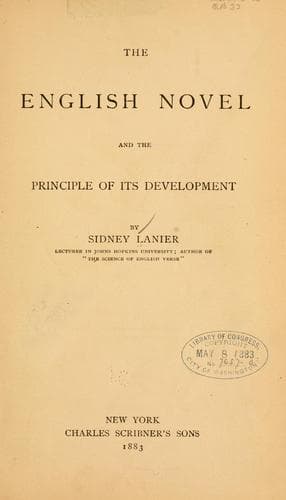
The English Novel and the Principle of its DevelopmentLanier, Sidney
History
The English Novel and the Principle of its Development
Lanier, Sidney
English fiction -- History and criticism
suicide in Minnesota, yesterday, by choking himself with a twisted
sheet. These are all the items involving the moral relations of man to
man contained in the history of the world for Tuesday, March 22d,
1881, as given by a journal noted for the extent and accuracy of its
daily collection.
Now suppose a picture were drawn of the moral condition of the United
States from these data: how nearly would it represent the facts? This
so-called "history of the world for one day," if you closely examine
it, turns out to be, you observe, only a history of the world's crimes
for one day. The world's virtues do not appear. It is true that
Patrick Kelly murdered his wife yesterday; but then how many Kellys
who came home, tired from work, and found the wife drunk and the
children crying for bread, instead of murdering the whole family, with
a rugged sigh drew the beastly woman's form into one corner, fumbled
about the poor, dirty cupboard in another for crusts of bread, fed the
crying youngsters after some rude fashion, and finally lay down with
dumb heaviness to sleep off the evil of that day. It is true that
Jones, the bank clerk, was yesterday exposed in a series of
defalcations; but how many thousands of bank clerks on that same day
resisted the strongest temptations to false entries and the
allurements of private stock speculations. It is true that yesterday
Mrs. Lighthead eloped with the music-teacher, leaving six children and
a desolate husband; but how many thousands of Mrs. Heavyhearts spent
the same day in nursing some drunken husband, who had long ago
forfeited all love; how many Milly Bartons were darning six children's
stockings at five o'clock of that morning; nay, what untold millions
of faithful women made this same day a sort of paradise for husband
and children. And finally, you have but to consider a moment that if
it lay within the power of the diligent collector of items for the
Associated Press despatches to gather together the virtuous, rather
than the criminal actions of mankind, the virtuous would so far exceed
the criminal as that no journal would find columns enough to put them
in, so as to put a wholly different complexion upon matters. Now the
use of this newspaper illustration in my present argument is this: I
complain that Thackeray, and the Fielding school, in professing to
paint men as they _are_, really paint men only as they _appear_ in
some such necessarily one-sided representations as the newspaper
history just described. And it is perfectly characteristic of the
inherent weakness of Thackeray that he should so utterly fail to see
the true significance underlying society's repudiation of his proposed
natural picture. The least that such a repudiation _could_ mean, would
be that even if the picture were good in Fielding's time, it is bad
now. It is beautiful, therefore, remembering Thackeray's great
influence at the time when _Scenes from Clerical Life_ were written,
Public-domain text, read in full here on John Shaqi.
Reviews
Reviews
No reviews yet
Be the first to share your thoughts on this work.
Elsewhere in the archive
Join the Discussion
Join the discussion
Sign in to leave a comment or review.
Sign InorCreate an account