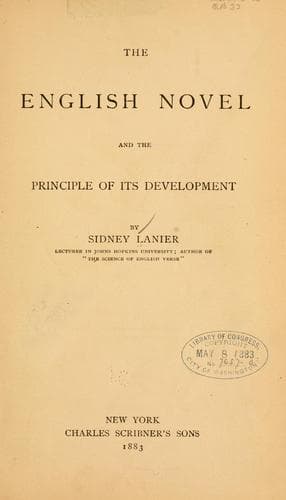
The English Novel and the Principle of its DevelopmentLanier, Sidney
History
The English Novel and the Principle of its Development
Lanier, Sidney
English fiction -- History and criticism
(Pause, during which Gwendolen reflected that the life of an
unmarried woman who could not go about and had no command of
anything, must necessarily be dull through all the degrees of
comparison as time went on.)
"You have made yourself queen of it. I imagine you will carry the
first prize."
"I don't know that. I have great rivals. Did you not observe how
well Miss Arrowpoint shot?"
(Pause, wherein Gwendolen was thinking that men had been known to
choose some one else than the woman they most admired, and
recalled several experiences of that kind in novels.)
At this point we come upon an element of difference between the novel
and the drama which has not hitherto been fairly appreciated, so far
as I know. Consider for a moment the wholly supernatural power which
is necessarily involved in the project of thus showing the most secret
workings of the mind and heart of this young girl Gwendolen Harleth!
In real life what power less than God's can make me see the deepest
thought and feeling of a fellow-creature? But since the novel is
always a transcript of real, or at any rate of possible, life, you
observe that wherever these workings of heart and brain are thus laid
bare, the tacit supposition is, in plain terms, that God is the
writer, or that the writer is a god. In the drama no supposition is
necessary because here we become acquainted with only such matters as
are shown us in the ordinary way, by scenery or by the speech or
gesture of the actor. This consideration seems to me to lift the novel
to the very highest and holiest plane of creative effort; he who
takes up the pen of the novelist assumes, as to that novel, to take up
along with it the omniscience of God. He proposes, in effect, to bring
about the revelations of Judgment Day long before the trumpet has
sounded. George Eliot shows us the play of Gwendolen Harleth's soul
with the same uncompromising fulness with which the most literal
believer expects to give account of the deeds done in the body at the
last day.
In contemplating this vast ascent from the attitude of the dramatist
to that of the novelist--the dramatist is a man; the novelist--as to
that novel, is a god--we are contemplating simply another phase of the
growth of man from Shakspeare to George Eliot.
Public-domain text, read in full here on John Shaqi.
Reviews
Reviews
No reviews yet
Be the first to share your thoughts on this work.
Elsewhere in the archive
Join the Discussion
Join the discussion
Sign in to leave a comment or review.
Sign InorCreate an account