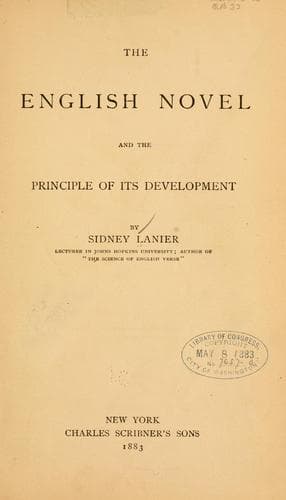
The English Novel and the Principle of its DevelopmentLanier, Sidney
History
The English Novel and the Principle of its Development
Lanier, Sidney
English fiction -- History and criticism
And we reach still another view of that growth when we reflect that
even if Shakspeare could have overcome the merely mechanical
difficulty of presenting a repentance without overmuch soliloquy, he
would probably have found but poorly-paying houses at the Globe
Theatre to witness any drama so purely spiritual as that which George
Eliot has shown us going on upon the little ill-lighted stage of a
young girl's consciousness. Just as we found that the prodigious
advance in the nearness of man to his fellow from the time of Æschylus
to that of George Eliot was implied in the fact that the latter could
gather an interested audience about a couple of commonplace children
(as in _The Mill on the Floss_), whilst the former required the larger
stimulus of Titanic quarrel and angry Jove; so here we have reached an
evidence of still more subtle advance as between the times of
Shakspeare and of George Eliot when we find the latter gathering a
great audience about this little inward, actionless, complex drama of
Gwendolen Harleth, while we reflect that Shakspeare must have his
stimulant passion, his crime, his patriotism, and the like, as the
only attracting motives. In truth I find what seems to be a cunning
indication that George Eliot herself did not feel quite sure of her
audience for this same little play. At the end of Chapter XI., she
breaks off from a description of one of Gwendolen's capricious turns,
and as if in apologetic defense says:
"Could there be a slenderer, more insignificant thread in human
history than this consciousness of a girl, busy with her small
inferences of the way in which she could make her life
pleasant?--in a time, too, when ideas were with fresh vigor
making armies of themselves and the universal kinship was
declaring itself fiercely; ... a time when the soul of man was
waking to pulses which had for centuries been beating in him
unheard.... What, in the midst of that mighty drama, are girls
and their blind visions? They are the Yea or Nay of that good for
which men are enduring or fighting. In these delicate vessels is
borne onward through the ages the treasure of human affections."
Public-domain text, read in full here on John Shaqi.
Reviews
Reviews
No reviews yet
Be the first to share your thoughts on this work.
Elsewhere in the archive
Join the Discussion
Join the discussion
Sign in to leave a comment or review.
Sign InorCreate an account