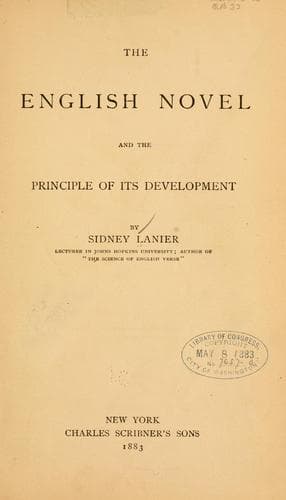
The English Novel and the Principle of its DevelopmentLanier, Sidney
History
The English Novel and the Principle of its Development
Lanier, Sidney
English fiction -- History and criticism
Thus it appears that for Shakspeare to draw such repentances as
Gwendolen Harleth's was not only difficult from the playwright's point
of view, but premature from the point of view of the world's growth.
In truth, I suspect, if we had time to pursue this matter, that we
should find it leading us into some very instructive views of certain
rugged breaking-off places in Shakspeare. I suppose we must consider
the limitations of his time; though it is just possible there may be
limitations of his genius, also. We should presently find ourselves
asking further how it is that Shakspeare not only never drew a great
reformation, but never painted a great reformer? It seems a natural
question: How is it, that it is Milton, and not Shakspeare, who has
treated the subject of Paradise Lost and Regained; how is it, that
the first-class subject was left for the second-class genius? We all
know how Milton has failed in what he intended with his poem, and how
astonished he would be at finding that the only one of his characters
which has taken any real hold upon the world is his Satan. It seems
irresistible to ask ourselves why might not our most eloquent tongue
have treated our most lofty theme? Or, if we should find special
reasons in the temper of his time why Shakspeare could not or should
not have treated this theme, we may still ask, why did he never paint
for us one of those men who seem too large to be bounded in their
affections merely by limits of country, but who loved and worked for
the whole world, Buddha, Zoroaster, Mahomet, Socrates, Luther; nay,
why may not the master have given us a master's picture of Christopher
Columbus, or even of John Vanini, the scientific martyr; even of the
fantastic Giordano Bruno, who against all warnings boldly wandered
from town to town defending his doctrines until he was burned, in
1600? And if any of the academicians now in my audience should incline
to pursue this strange psychologic literary problem, I make no doubt
that useful light would be cast upon the search if you should consider
along with these questions the further inquiries why Shakspeare never
mentions either of the two topics which must have been foremost in the
talk of his time: namely, America and tobacco. Among all the allusions
to contemporary matter in his plays the nearest he ever comes to
America is the single instance in _The Tempest_, where Ariel is
mentioned as "fetching dew from the still-vexed Bermoothes"
(Bermudas). As for tobacco; although pretty much all London must have
been smoking vigorously about the time Shakspeare was writing _Much
Ado About Nothing_ and _The Merry Wives of Windsor_; although
certainly to a countryman not a great while out of the woods of
Warwickshire it must have been the oddest of sights to see people
sucking at hollow tubes and puffing smoke from their mouths and
nostrils; although, too, the comedies of his contemporaries are often
cloudy with tobacco smoke: nevertheless there is not, so far as my
Public-domain text, read in full here on John Shaqi.
Reviews
Reviews
No reviews yet
Be the first to share your thoughts on this work.
Elsewhere in the archive
Join the Discussion
Join the discussion
Sign in to leave a comment or review.
Sign InorCreate an account