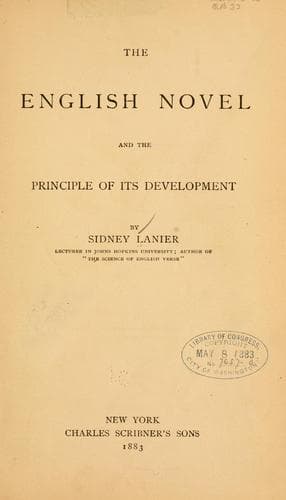
The English Novel and the Principle of its DevelopmentLanier, Sidney
History
The English Novel and the Principle of its Development
Lanier, Sidney
English fiction -- History and criticism
recollection goes, the faintest allusion to the drinking of tobacco
(as it was then called), in the whole body of his writings. Now all
these omissions are significant because conspicuous; always, in
studying genius, we learn as much from what it has not done, as from
what it has done; and if research should succeed in arranging these
neglects from any common point of view, it is possible that something
new might still be said about Shakspeare.
But, to return to _Daniel Deronda_. A day or two after George Eliot's
death the _Saturday Review_ contained an elaborate editorial summary
of her work. For some special ends, permit me to read so much of it as
relates to the book now under consideration. "_Daniel Deronda_ is
devoted to the whimsical object of glorifying real or imaginary Jewish
aspirations. It cannot be doubted that so fantastic a form of
enthusiasm was suggested by some personal predilection or association.
A devotion to the Jewish cause unaccompanied by any kind of interest
in the Jewish religion is not likely to command general sympathy; but
even if the purpose of the story had been as useful as it is
chimerical and absurd, the inherent fault of didactic fiction would
scarcely have been diminished.... It is significant that when George
Eliot deliberately preferred the function of teaching to her proper
office of amusing she sacrificed her power of instruction as well as
her creative faculty."
Of course, in general, no man in his senses thinks of taking in
serious earnest every proposition in the _Saturday Review_. It is an
odd character which long ago assumed the role of teasing English
society by gravely advancing any monstrous assertions at random and
laughing in its sleeve at the elaborate replies with which these
assertions would be honored by weak and unsuspecting people. But its
position upon this particular point of _Daniel Deronda_ happens to be
supported by similar views among her professed admirers.
Even _The Spectator_ in its obituary notice completely mistakes the
main purpose of _Daniel Deronda_; in declaring that "she takes
religious patriotism for the subject," though as I have just
indicated, surely the final aim of the book is to furnish to two young
modern people a motive sufficient to make life not only worth living
but fascinating; and of the two distinct plots in the book one--and
the one to which most attention is paid--hinges upon Gwendolen
Harleth's repentance, while it is only the other and slighter which is
concerned with what these papers call religious patriotism, and here
the phrase "religious patriotism" if we examine it is not only
meaningless--what is religious patriotism?--but has the effect of
dwarfing the two grand motives which are given to _Daniel Deronda_;
namely religion and patriotism.
Public-domain text, read in full here on John Shaqi.
Reviews
Reviews
No reviews yet
Be the first to share your thoughts on this work.
Elsewhere in the archive
Join the Discussion
Join the discussion
Sign in to leave a comment or review.
Sign InorCreate an account