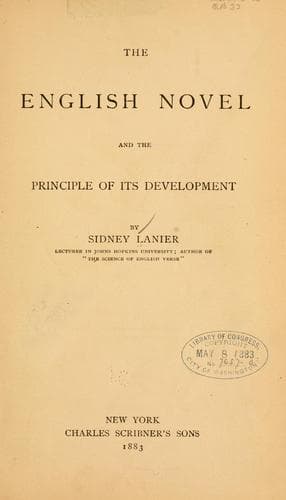
The English Novel and the Principle of its DevelopmentLanier, Sidney
History
The English Novel and the Principle of its Development
Lanier, Sidney
English fiction -- History and criticism
She had been persuaded to this step by Dr. Chapman, who was at that
time editor of the _Westminster Review_, and who asked her to come and
help him to conduct that publication. At this time she must have been
one of the most captivating companions imaginable. She knew French,
German and Italian, and had besides a good knowledge of Latin, Greek,
Russian and Hebrew. She was a really good player of the piano, and had
some proficiency on the organ; she had already mixed in some of the
best society of London, for, in 1841, her father had moved to
Foleshill, near Coventry, and here she quickly became intimate in the
household of Mr. and Mrs. Charles Bray, where she met such people as
Emerson, George Combe, Mr. Froude, and many other noted ones of the
literary circles which the Brays delighted in drawing about them; her
mind had been enlarged by the treasures of the Continent which she
visited with her life-long friends, the Brays, in 1849, after the
death of her father, remaining at Geneva after the Brays returned to
England; she had all that homely love which comes with the successful
administration of breakfast, dinner and supper, for her sisters and
brothers had all married, and she lived alone with her father after
his removal to Coventry in 1841, and kept his house for him from that
time until his death, not only with great daughterly devotion but, it
is said, with great success as a domestic manager; besides thus
knowing the mysteries of good coffee and good bread she was widely
versed in theology, philosophy and the movements of modern science:
all of which equipment was permeated with a certain intensity which
struck every one who came near her. With this endowment she came to
London in 1851, as I have said, by Dr. Chapman's invitation, and took
up her residence at Dr. Chapman's house. Here she immediately began to
meet George H. Lewes, Carlyle, Mill and Herbert Spencer. Of her
relations to Lewes it seems to me discussion is not now possible. It
is known that Lewes' wife had once left him, that he had generously
condoned the offense and received her again, and that in a year she
again eloped; the laws of England make such a condonation preclude
divorce; Lewes was thus prevented from legally marrying again by a
technicality of the law which converted his own generosity into a
penalty; under these circumstances George Eliot, moved surely by pure
love, took up her residence with him, and according to universal
account, not only was a faithful wife to him for twenty years until
his death, but was a devoted mother to his children. That her failure
to go through the form of marriage was not due to any contempt for
that form, as has sometimes been absurdly alleged, is conclusively
shown by the fact that when she married Mr. Cross, a year and a half
after Lewes' death, the ceremony was performed according to the
regular rites of the Church of England.
Public-domain text, read in full here on John Shaqi.
Reviews
Reviews
No reviews yet
Be the first to share your thoughts on this work.
Elsewhere in the archive
Join the Discussion
Join the discussion
Sign in to leave a comment or review.
Sign InorCreate an account