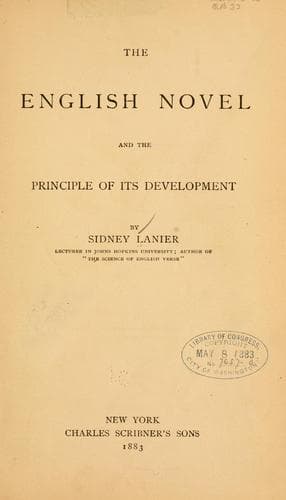
The English Novel and the Principle of its DevelopmentLanier, Sidney
History
The English Novel and the Principle of its Development
Lanier, Sidney
English fiction -- History and criticism
The most congenial of George Eliot's acquaintances during these early days
at the Chapman's in London was Mr. Herbert Spencer. For a long time indeed
the story went the rounds that Mr. Spencer had been George Eliot's tutor;
but you easily observe that when she met him at this time in London she was
already thirty-one years old, long past her days of tutorship. The story
however has authoritatively been denied by Mr. Spencer himself. That George
Eliot took pleasure in his philosophy, that she was especially conversant
with his _Principles of Psychology_, and that they were mutually-admiring
and mutually-profitable friends, seems clear enough; but I cannot help
regarding it a serious mistake to suppose that her novels were largely
determined by Mr. Spencer's theory of evolution, as I find asserted by a
recent critic who ends an article with the declaration that "the writings
of George Eliot must be regarded, I think, as one of the earliest triumphs
of the Spencerian method of studying personal character and the laws of
social life."
This seems to me so far from being true that many of George Eliot's
characters appear like living objections to the theory of evolution.
How could you, according to this theory, evolve the moral stoutness
and sobriety of Adam Bede, for example, from _his_ precedent
conditions, to wit, his drunken father and querulous mother? How
could you evolve the intensity and intellectual alertness of Maggie
Tulliver from _her_ precedent conditions, to wit, a flaccid mother,
and a father wooden by nature and sodden by misfortune? Though surely
influenced by circumstances her characters everywhere seem to flout
evolution in the face.
But the most pleasant feature connected with the intercourse of George
Eliot and Herbert Spencer is that it appears to have been Mr. Spencer
who first influenced her to write novels instead of heavy essays in
_The Westminster_. It is most instructive to note that this was done
with much difficulty. Only after long resistance, after careful
thought, and indeed after actual trial was George Eliot persuaded that
her gift lay in fiction and not in philosophy; for it was pending the
argument about the matter that she quietly wrote _Scenes from Clerical
Life_ and caused them to be published with all the precaution of
anonymousness, by way of actual test.
Public-domain text, read in full here on John Shaqi.
Reviews
Reviews
No reviews yet
Be the first to share your thoughts on this work.
Elsewhere in the archive
Join the Discussion
Join the discussion
Sign in to leave a comment or review.
Sign InorCreate an account