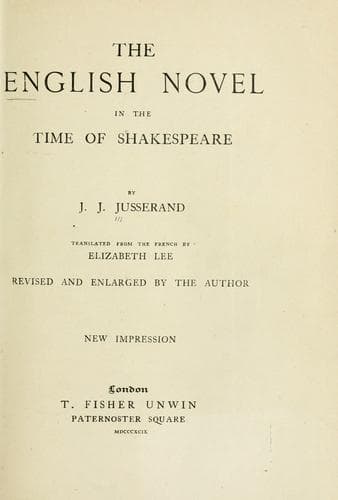
The English Novel in the Time of ShakespeareJusserand, J. J. (Jean Jules)
History
The English Novel in the Time of Shakespeare
Jusserand, J. J. (Jean Jules)
English fiction -- Early modern, 1500-1700 -- History and criticism
The London publishers annually issue statistics of the works that have
appeared in England during the year. Sometimes sermons and books on
theology reach the highest figures; England is still the England of the
Bible, the country that at the time of the Reformation produced three
hundred and twenty-six editions of the Scriptures in less than a
century, and whose religious literature is so abundant that to-day
twenty-eight volumes of the British Museum catalogue treat of the single
word Bible. When theology does not obtain the first rank, it holds the
second. The only writings that can compete with it, in the country of
Shakespeare, of Bacon and of Newton, are neither dramas, nor books of
philosophy nor scientific treatises; they are novels. Theology had the
supremacy in 1885; novels obtained it in 1887, 1888, and 1889. Omitting
stories written for children, nine hundred and twenty-nine novels were
published in England in 1888, and one thousand and forty in 1889. Thus
the conscientious critic who wished to acquaint himself with all of them
would have to read more than two novels and a half, often in three
volumes, every day all the year round, without stopping even on Sundays.
This passion for the novel which does not exist in the same degree in
any other nation, only acquired its full strength in England in the
eighteenth century. At that time English novels produced in Europe the
effect of a revelation; they were praised extravagantly, they were
copied, they were imitated, and the popularity hitherto enjoyed by the
"Princesse de Cleves," "Marianne," and "Gil Blas," was obscured for a
while. "I say that Anglicism is gaining on us," wrote d'Argenson; "after
'Gulliver' and 'Pamela,' here comes 'Tom Jones,' and they are mad for
him; who could have imagined eighty years ago that the English would
write novels and better ones than ours? This nation pushes ahead by
force of unrestricted freedom."[1]
Modern society had at length found the kind of literature which could
be most suitably employed to depict it. Society had been presented on
the English stage by the authors of domestic comedies; Steele and
Addison had painted it in their essays. But in both forms the portrait
was incomplete. The exigencies of the stage, the necessary brevity of
the essay, made it impossible to give adequate expression to the
infinite complexity of the subject. The novel created anew by Defoe,
Fielding, and Richardson, made it an easy thing to introduce into the
arena of literature those men and women of intelligence and feeling who,
for long ages, had been pleased to see other people the chief subjects
of books and inwardly desired that authors should at last deal more
especially with themselves. The age of chivalry was gone; the time of
the Arthurs and the Tristans had passed away; such a society as the new
one could not so well be sung in verse; but it could extremely well be
described in prose.
Public-domain text, read in full here on John Shaqi.
Reviews
Reviews
No reviews yet
Be the first to share your thoughts on this work.
Join the Discussion
Join the discussion
Sign in to leave a comment or review.
Sign InorCreate an account