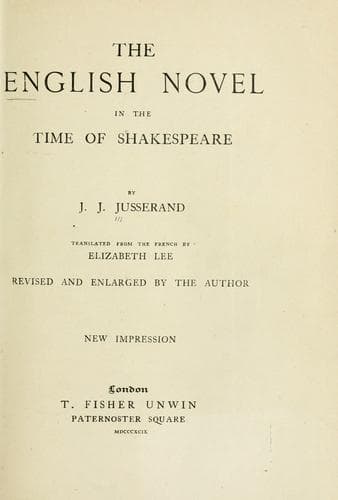
The English Novel in the Time of ShakespeareJusserand, J. J. (Jean Jules)
History
The English Novel in the Time of Shakespeare
Jusserand, J. J. (Jean Jules)
English fiction -- Early modern, 1500-1700 -- History and criticism
As Fielding remarked, the novel takes the place of the old epic. We
think of the Harlowes when in the olden time we should have dreamed of
the Atridae. While man's attachment to science and demonstrated truth is
growing year by year, so, simultaneously, the art of the historian and
the art of the novelist, both essentially empirical, become more highly
valued and more widely cultivated. As for the lengthy tales devoted to
Tristan and to "l'Empereur magne," we know that their day is done, and
we think of them with all the pensive tenderness we cannot help feeling
for the dead, for the dim past, for a race without posterity, for
childhood's cherished and fast-fading dreams. Thus in the same age when
Clarissa Harlowe and Tom Jones came to their kingdom, the poets
Chatterton, Percy, Beattie, and others, turned back lovingly to the
Middle Ages; and thus too the new taste for history, archaeology, and the
painting of real life, all put together and combined, ended by producing
a particular school of novel, the _romantic_ school, at whose head
stands Sir Walter Scott.
Perhaps, however, something besides poetry is to be sought for in these
bygone epochs. Movements of human thought have seldom that suddenness
with which they are sometimes credited; if those literary innovations,
apparently so spasmodic, are carefully and closely studied, it will be
nearly always found that the way had been imperceptibly prepared for
them through the ages. We are in the habit of beginning the history of
the English novel with Defoe or Richardson; but was there no work of the
kind in England before their time? had they to invent it all, matter and
method? It is not enough to say that the gift of observation and
analysis was inborn in the race, as shown already, long before the
eighteenth century, in the work of the dramatists, moralists and
philosophers. Had not the same gift already manifested itself in the
novel?
Public-domain text, read in full here on John Shaqi.
Reviews
Reviews
No reviews yet
Be the first to share your thoughts on this work.
Join the Discussion
Join the discussion
Sign in to leave a comment or review.
Sign InorCreate an account