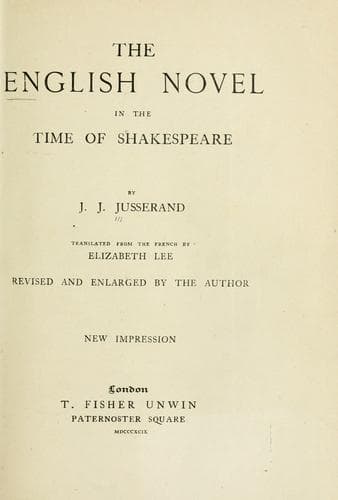
The English Novel in the Time of ShakespeareJusserand, J. J. (Jean Jules)
History
The English Novel in the Time of Shakespeare
Jusserand, J. J. (Jean Jules)
English fiction -- Early modern, 1500-1700 -- History and criticism
The truth is that the novel shed its first splendour during the age of
Elizabeth; but the glory of Shakespeare has overshadowed the multitude
of the lesser authors of his time, a multitude which included the early
novelists. While they lived, however, they played no insignificant part;
now they are so entirely forgotten that it will perhaps be heard with
some surprise that they were prolific, numerous, and very popular. So
great was the demand for this kind of literature that some succeeded in
making an income out of their novels. Their books went through many
editions for that age, many more than the majority of Shakespeare's
plays. They were translated into French at a time when even the name of
the great dramatist was entirely unknown to the French people. Lyly's
"Euphues," for example, went through five editions in five years; in the
same period "Hamlet" passed through only three, and "Romeo and Juliet"
through two editions. Not a line of Shakespeare was put into French
before the eighteenth century, while prose fictions by Nash, Greene, and
Sidney were translated more than a century earlier.
As in our own day, some of these novelists busied themselves chiefly
with the analysis of passion and refined emotion; others chiefly
concerned themselves with minute observation of real life, and strove to
place before the reader the outward features of their characters in a
fashion impressive enough to enable him to realize what lay below the
surface. Many of these pictures of manners and of society were
considered by contemporaries good likenesses, not the less so because
embellished. Thus, having served as models to the novelists, the men and
women of the day in their turn took as example the copies that had been
made from them. They had had their portraits painted and then tried hard
to resemble their counterfeit presentments. Lyly and Sidney embellished,
according to the taste of the age, the people around them, whom they
chose as patterns for the heroes of their novels; and as soon as their
books were spread over the country, fashionable ladies distinguished
themselves from the common sort by being "Arcadian" or "Euphuizd."[2]
Thus through these very efforts, a literature, chiefly intended for
women, was arising in England, and this is one characteristic more that
links these authors to our modern novelists. So that, perhaps, bonds,
closer than we imagine, unite those old writers lost in a far-off past
with the novelists whose books reprinted a hundred times are to be found
to-day on every reading-table and in everybody's hands.
Public-domain text, read in full here on John Shaqi.
Reviews
Reviews
No reviews yet
Be the first to share your thoughts on this work.
Join the Discussion
Join the discussion
Sign in to leave a comment or review.
Sign InorCreate an account