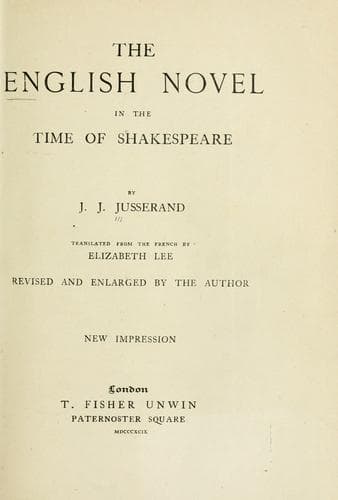
The English Novel in the Time of ShakespeareJusserand, J. J. (Jean Jules)
History
The English Novel in the Time of Shakespeare
Jusserand, J. J. (Jean Jules)
English fiction -- Early modern, 1500-1700 -- History and criticism
Sidney, thus possesses the merit, unique at that time with prose
writers, of varying his subjects by marking its _nuances_ and by
describing in his romance different kinds of love. Side by side with
Gynecia's passion, he has set himself to paint the love of an old man in
Basilius, of a young man in Pyrocles, of a young girl in Pamela. This
last study led him to portray a scene which was to be represented again
by one of the great novelists of the eighteenth century. Richardson
borrowed from Sidney, with the name of Pamela, the idea of the adventure
that shows her a prisoner of her enemies, imploring heaven that her
virtue may be preserved. The wicked Cecropia who keeps Sidney's Pamela
shut up, laughs heartily at her invocations: "To thinke," she says,
"that those powers, if there be any such, above, are moved either by the
eloquence of our prayers, or in a chafe at the folly of our actions,
carries as much reason, as if flies should thinke that men take great
care which of them hums sweetest, and which of them flies nimblest."
Pamela, "whose cheeks were dyed in the beautifullest graine of vertuous
anger," replies by speeches which yield in nothing as regards nobility
and dignity, and length also, to those of her future sister, and which
are followed as in Richardson, by an unexpected deliverance. These
speeches are famous for yet another reason; they are said to have been
recited in one of the most terrible crises of the history of England and
were not this time followed by a deliverance. Charles I., it is
reported, had copied out, and recited a short time before his death, the
eloquent prayers to God, of the young heroine of Sidney's novel. It
seems that Pamela's prayer figured among the papers that he gave with
his own hand, at the last moment, to the prelate who was attending him:
and the Puritans, Milton especially, uttered loud cries, and saw in this
reminiscence of the artist-prince, an insult to the divine majesty.
"This King," writes the poet, "hath as it were unhallowed and
unchristened the very duty of prayer itself, by borrowing to a Christian
use prayers offered to a heathen god. Who would have imagined so little
fear in him of the true all-seeing deity, so little reverence of the
Holy Ghost, whose office is to dictate and present our Christian
prayers, so little care of truth in his last words, or honour to himself
or to his friends, or sense of his afflictions or of that sad hour which
was upon him, as immediately before his death to pop into the hand of
that grave bishop who attended him, for a special relique of his saintly
exercises, a prayer stolen word for word from the mouth of a heathen
woman, praying to a heathen god, and that in no serious book, but in
the vain amatorious poem of Sir Philip Sidney's Arcadia."[206] Here is
this prayer which is a very grave and eloquent one, and in no way
justifies the bitter reproaches addressed to Charles by his enemies:
Public-domain text, read in full here on John Shaqi.
Reviews
Reviews
No reviews yet
Be the first to share your thoughts on this work.
Elsewhere in the archive
Join the Discussion
Join the discussion
Sign in to leave a comment or review.
Sign InorCreate an account