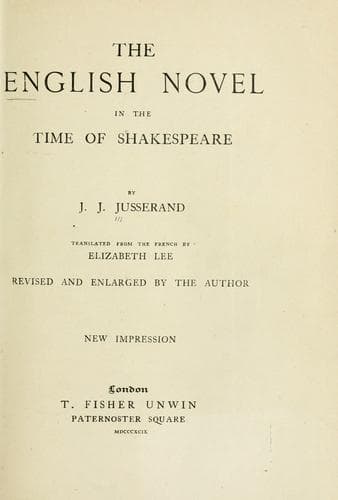
The English Novel in the Time of ShakespeareJusserand, J. J. (Jean Jules)
History
The English Novel in the Time of Shakespeare
Jusserand, J. J. (Jean Jules)
English fiction -- Early modern, 1500-1700 -- History and criticism
"Kneeling down, even where she stood, she thus said: O All-seeing Light,
and eternall Life of all things, to whom nothing is either so great,
that it may resist, or so small that it is contemned: looke upon my
misery with thine eye of mercy, and let thine infinite power vouchsafe
to limit out some proportion of deliverance unto mee, as to thee shall
seeme most convenient. Let not injurie, O Lord, triumph over mee, and
let my faults by thy hand bee corrected, and make not mine unjust enemy
the minister of thy Justice. But yet, my God, if, in thy wisedome, this
be the aptest chastisement for my unexcusable folly; if this low bondage
be fittest for my over-high desires; if the pride of my not enough
humble heart, be thus to be broken, O Lord, I yeeld unto thy will, and
joyfully embrace what sorrow thou wilt have me suffer. Onely thus much
let me crave of thee ... let calamity be the exercise, but not the
overthrow of my vertue: let their power prevaile, but not prevaile to
destruction: let my greatnesse be their prey: let my paine be the
sweetnesse of their revenge: let them, if so it seem good unto thee,
vexe me with more and more punishment. But, O Lord, let never their
wickednesse have such a hand, but that I may carry a pure minde in a
pure body. And pausing a while: And, O most gracious Lord, said shee,
what ever become of me, preserve the vertuous Musidorus."[207]
Thus incidents, showing much diversity, but little order, follow each
other in great variety. There are touching episodes, ludicrous and, to
our modern ideas, even shocking episodes, brilliant adventures, fine
pastoral scenes, and much pleasant description; Sidney had been
perfectly frank and true when he had spoken of "his young head" and his
"many many fancies." He allows his imagination to wander; fancies are
swarming in his mind, and he is no more capable of restraining or
putting them into logical order than a man can restrain or introduce
reason into a dream. Arcadia is sometimes in England and sometimes in
Greece; Basilius' cottage sometimes becomes Hampton Court; there are
temples and churches also; heroes are Christians, but they believe in
Mars; they act according to the Gospel and also according to the
oracles; they are before everything men of the Renaissance. Following
his vein, Sidney, after innumerable adventures, pastoral and warlike
scenes, disappearances, unexpected meetings, scenes of deep love, of
criminal, sweet or foolish love, comes at last to a sort of conclusion.
King Basilius drinks a soporific draught; he is given up as dead. Queen
Gynecia is accused of being the author of the deed; Zelmane, who has
been found out to be a man is adjudged an accomplice; both are about to
be executed. At that point, fortunately, the dead king springs to his
feet; there are explanations, embracings, and a general pardon. Good
Basilius, who alone seems to have understood nothing of all that
happened, asks pardon of his wife and of the world at large for his
Public-domain text, read in full here on John Shaqi.
Reviews
Reviews
No reviews yet
Be the first to share your thoughts on this work.
Elsewhere in the archive
Join the Discussion
Join the discussion
Sign in to leave a comment or review.
Sign InorCreate an account