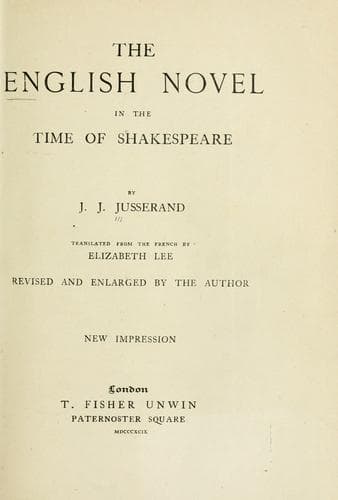
The English Novel in the Time of ShakespeareJusserand, J. J. (Jean Jules)
History
The English Novel in the Time of Shakespeare
Jusserand, J. J. (Jean Jules)
English fiction -- Early modern, 1500-1700 -- History and criticism
Jack is careful not to touch at once on the matter in his head: he knows
his man and attacks him first by that vanity of a noble descent which he
possesses in common with Falstaff. Jack has always borne him affection,
"partly for the high discent and linage from whence he sprung, and
partly for the tender care and provident respect he had of poore
soldiers ... he vouchsafed in his own person to be a victualer to the
campe: a rare example of magnificence and courtesie; and diligently
provided, that without farre travel, every man might have for his money
syder and cheese his bellyfull. Nor did he sell his cheese by the way
onely, or his syder by the great, but abast himselfe with his owne hands
to take a shoomakers knife: a homely instrument for such a high
personage to touch, and cut it out equally like a true justiciarie in
little penny-worthes that it would doo a man good for to looke upon. So
likewise of his syder, the pore man might have his moderate draught of
it (as there is moderation in all things) as well for his doit or his
dandiprat as the rich man for his halfe souse or his denier ..."
Jack goes on irrepressible, overflowing; it is his best moment; he does
not want the sport to end too quickly: "Why, you are everie childs
felow: any man that comes under the name of a souldier and a good
fellowe, you will sitte and beare companie to the last pot, yea, and you
take in as good part the homely phrase of: 'Mine host heeres to you,' as
if one saluted you by all the titles of your baronie. These
considerations, I saie, which the world suffers to slip by in the
channell of carelesnes, have moved me in ardent zeale of your welfare,
to forewarne you of some dangers that have beset you and your barrels.
"At the name of dangers hee start up, and bounst with his fist on the
boord so hard, that his tapster overhearing him cried: 'Anon! anon!
sir,' and entering with a bow askt him what he wanted.
"Hee was readie to have stricken his tapster for interrupting him in
attention of this his so much desired relation, but for feare of
displeasing me he moderated his furie, and onely sending him for the
other fresh pint, wild him looke to the barre, and come when he is cald
with a devilles name.
Public-domain text, read in full here on John Shaqi.
Reviews
Reviews
No reviews yet
Be the first to share your thoughts on this work.
Elsewhere in the archive
Join the Discussion
Join the discussion
Sign in to leave a comment or review.
Sign InorCreate an account