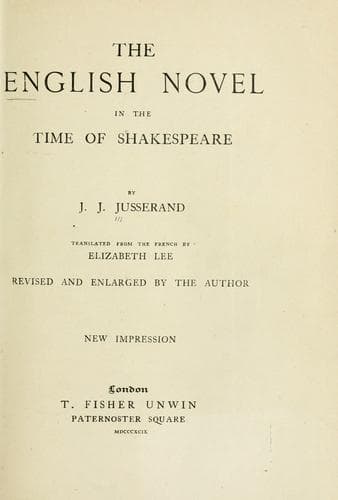
The English Novel in the Time of ShakespeareJusserand, J. J. (Jean Jules)
History
The English Novel in the Time of Shakespeare
Jusserand, J. J. (Jean Jules)
English fiction -- Early modern, 1500-1700 -- History and criticism
"Well, at his earnest importunitie, after I had moistned my lips, to
make my lie run glib to his journies end, forward I went as followeth
..." And the good apostle stops again; the cider and his own words have
moved him; he is a little fuddled, so is mine host; they both fall to
weeping. The innkeeper is ready to believe anything, and at this moment,
which is the right one the page at length determines to inform him that
in an assembly where he was present, he heard mine host, the purveyor of
the camp, accused of connivance with the enemy, by giving information to
the besieged through letters hidden in his empty barrels. High treason
is suspected! How are these dangerous rumours to be dissipated? There is
only one way of doing it, that is in becoming popular in the army, very
popular; he must make himself beloved by all; he must distribute cider
freely and for a time suppress in his shop the unbecoming custom of
paying.
The victualler follows this advice, but soon the trick is discovered;
the page is roundly whipped, but being to the core a true picaroon,
Wilton does not for all that feel his spirit in any way lessened: "Here
let me triumph a while, and ruminate a line or two on the excellence of
my wit!" This is all the sorrow and repentance the whip extracts from
him.
Shakespeare, two years later, fused the two characters into one, caused
the wit of the page to enter the brain of the fat man, and the blending,
animated by his genius, produced the inimitable customer of the "Boar's
Head" tavern.
After various adventures, Wilton returns to London, and struts about in
fine clothes, whose originality he describes with an amusing rush of
language: "I had my feather in my cap as big as a flag in the fore-top;
... my cape cloake of blacke cloth, over-spreading my backe like a
thornbacke or an elephantes eares, ... and in consummation of my
curiositie my hands without gloves, all a mode French." The sense of the
picturesque, the careful observation of the effect of a pose, of a fold
of a garment, were, before Nash, entirely unknown to English novel
writers, and it was not until the eighteenth century, until the time of
Defoe, Fielding, and, above all, Sterne, that the author of "Jack
Wilton" was excelled in this special talent.
Public-domain text, read in full here on John Shaqi.
Reviews
Reviews
No reviews yet
Be the first to share your thoughts on this work.
Elsewhere in the archive
Join the Discussion
Join the discussion
Sign in to leave a comment or review.
Sign InorCreate an account