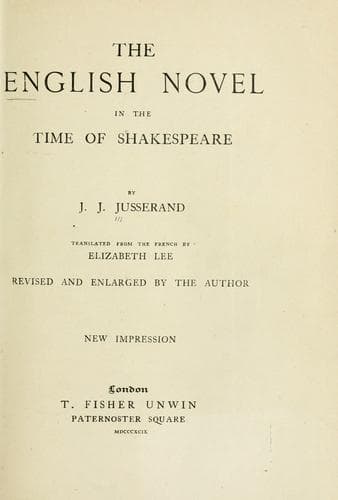
The English Novel in the Time of ShakespeareJusserand, J. J. (Jean Jules)
History
The English Novel in the Time of Shakespeare
Jusserand, J. J. (Jean Jules)
English fiction -- Early modern, 1500-1700 -- History and criticism
Nash's ghost was most certainly hovering about Dekker when he was
writing the pamphlet from which this apostrophe is taken; it taught him
how to disrobe for our amusement the heroes of antique legends of their
dignified looks and dresses, and place their haloed selves in the open
daylight of the street below our window. With all his admiration for
Marlowe's performance Nash had told, in very ludicrous fashion indeed,
the story of Hero and Leander, associating in a manner unwarranted by
ancient historians their fate with the vicissitudes of Great Yarmouth
and the red herring. In the same way Dekker makes choice of that
exquisite tale of Orpheus which reads so pathetically in the prose of
King Alfred, and he tells it thus:
"Assist mee therefore, thou genius of that ventrous but zealous musicion
of Thrace, Euridice's husband, who being besotted on his wife, of whiche
sin none but ... should be guiltie, went alive with his fiddle at's
backe, to see if he could bail her out of that adamantine prison. The
fees he was to pay for her were jigs and countrey-daunces: he paid them;
the forfeits if he put on yellow stockings and lookt back upon her, was
her everlasting lying there, without bayle or mayne-prize. The loving
coxcomb could not choose but look backe, and so lost her: perhaps hee
did it because he would be rid of her. The morall of which is, that if a
man leave his owne busines and have an eie to his wives dooings, sheele
give him the slip though she runne to the divell for her labour."[300]
Public-domain text, read in full here on John Shaqi.
Reviews
Reviews
No reviews yet
Be the first to share your thoughts on this work.
Elsewhere in the archive
Join the Discussion
Join the discussion
Sign in to leave a comment or review.
Sign InorCreate an account