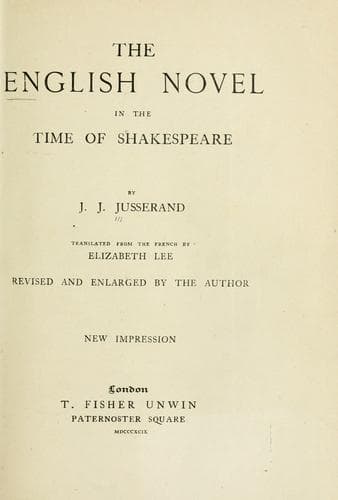
The English Novel in the Time of Shakespeare — John Shaqi
The English Novel in the Time of ShakespeareJusserand, J. J. (Jean Jules)
History
The English Novel in the Time of Shakespeare
Jusserand, J. J. (Jean Jules)
English fiction -- Early modern, 1500-1700 -- History and criticism
The first to awake were the scholars, the men who had studied in Paris.
It was quite natural that they should be less deeply impressed with
nationalism than the rest of their compatriots; learning had made them
cosmopolitan; they belonged less to England than to the Latin country,
and the Latin country had not suffered from the Conquest. Numerous
scholars of English origin shone forth as authors from the twelfth
century onwards; among them Geoffrey of Monmouth, of Arthurian fame,
Joseph of Exeter, John of Salisbury, Walter Map, Nigel Wireker, and many
others of European reputation.
In the thirteenth century another awakening takes place in the palace
which the Norman enchanter had doomed to a temporary sleep. Translators
and imitators set to work; the English language is again employed; the
storm has abated, and it has become evident that there still remain
people of English blood and language for whom it is worth while to
write. Innumerable books are composed for them, that they may learn,
ignorant as they are of French or Latin, what is the thought of the day.
Robert Manning de Brunne states, in the beginning of the fourteenth
century, that he writes:
"Not for the lerid bot for the lewed,
Ffor tho that in this land wone,
That the Latyn no Frankys cone,
Ffor to haf solace and gamen
In felawschip when thay sitt samen."
They are to enjoy this new literature in common, be it religious, be it
imaginative or historical; they will discuss it and it will improve
their minds; it will teach them to pass judgments even on kings:
"And gude it is for many thynges
For to here the dedis of kynges
Whilk were foles and whilk were wyse."[8]
In their turn the English poets sang of Arthur; in all good faith they
adopted his glory as that of an ancestor of their own. Among them a man
like Layamon accepted the French poet Wace for his model, and in the
beginning of the thirteenth century, devoted thirty-two thousand lines
to the Celtic hero; nor was he ever disturbed by the thought that
Arthur's British victories might have possibly been English defeats.[9]
Then came innumerable poems, translated or imitated from French
romances, on Charlemagne and Roland, Gawain and the Green Knight, Bovon
of Hanstone, Percival, Havelock the Dane, King Horn, Guy of Warwick,
Alexander, Octavian, and the Trojan War.[10] Hundreds of manuscripts,
some of them splendidly illuminated, testify at the present day to the
immense popularity of these imitations of French originals, and provide
endless labour for the many learned societies that in our century have
undertaken to print them.
Public-domain text, read in full here on John Shaqi.
Reviews
Reviews
No reviews yet
Be the first to share your thoughts on this work.
Join the Discussion
Join the discussion
Sign in to leave a comment or review.
Sign InorCreate an account