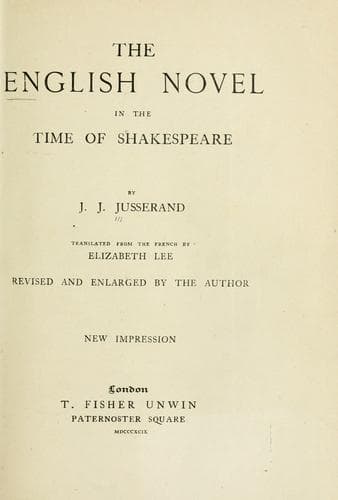
The English Novel in the Time of ShakespeareJusserand, J. J. (Jean Jules)
History
The English Novel in the Time of Shakespeare
Jusserand, J. J. (Jean Jules)
English fiction -- Early modern, 1500-1700 -- History and criticism
Layamon's indifference to the price paid by his compatriots for Arthur's
glory was not peculiar to himself. It is characteristic of a policy of
amalgamation deliberately followed from the beginning by the Normans. As
soon as they were settled in the country they desired to unify the
traditions of the various races inhabiting the great island, in the
belief that this was a first and necessary step towards uniting the
races themselves. Rarely was literature used for political purposes with
more cleverness and with more important results. The conquerors set the
example themselves, and from the first adopted and treated all the
heroic beings who had won glory in or for England, and whose fame
lingered in ballads and popular songs, as if they had been personal
ancestors of their own. At the same time they induced the conquered
race to adopt the theory that mythic Trojans were their progenitors, a
theory already discovered and applied by the French to their own early
history, and about which fables were already current among the Welsh
people: both races were thus connected together as lineal descendants,
the one of Brutus, the other of Francus; and an indissoluble link united
them to the classic nations of antiquity.[11] So it happened that in
mediaeval England French singers were to be heard extolling the glory of
Saxon kings, while English singers told the deeds of Arthur, the
arch-enemy of their race. Nothing gives a better idea of this
extraordinary amalgamation of races and traditions than a certain poem
of the thirteenth century written in French by a Norman monk of
Westminster, and dedicated to Eleanor of Provence, wife of Henry III.,
in which we read:
"In the world, I may confidently say, there never was country, kingdom
or empire, where so many good kings, and holy too, were found, as in the
English island.... Saints they were, martyrs and confessors, of whom
several died for God; others most strong and hardy, as were Arthur,
Edmund, and Knut."[12]
Public-domain text, read in full here on John Shaqi.
Reviews
Reviews
No reviews yet
Be the first to share your thoughts on this work.
Join the Discussion
Join the discussion
Sign in to leave a comment or review.
Sign InorCreate an account