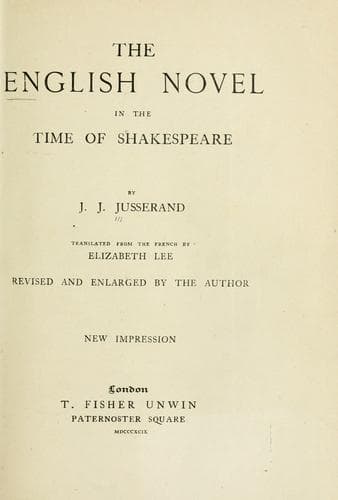
The English Novel in the Time of ShakespeareJusserand, J. J. (Jean Jules)
History
The English Novel in the Time of Shakespeare
Jusserand, J. J. (Jean Jules)
English fiction -- Early modern, 1500-1700 -- History and criticism
Any number of speeches of this sort are to be found in the heroical
dramas of Dryden, Settle, Lee, and their contemporaries. Roman, Arab,
Turk, Greek or Moorish heroes, pirates or princes, when they mean to set
anything at defiance, choose nothing less than heaven and earth as their
object; they divide the world between them as if it were an orange; they
rush to the fight or stop for a speech with a fine shake of the head
which sends a majestic undulation round the wig worn by them, even by
the Moors, as we may see in one of the very rare dramas then published
with engravings. They are represented there with embroidered
justaucorps, wigs and ribbons.[349]
Crowne besides his romance wrote several dramas that secured him a wide,
if temporary, popularity. He also adapted Racine's "Andromaque" for the
English stage, but he was very much disgusted with this work; the French
original, though not "the worst" of French plays, was after all so mean
and tame! "If the play be barren of fancy, you must blame the original
author. I am as much inclined to be civil to strangers as any man; but
then they must be strangers of merit. I would no more be at the pains to
bestow wit (if I had any) on a French play, than I would be at the cost
to bestow cloaths on every shabby Frenchman that comes over." Here we
have Racine put in his proper place; what claim had he to be considered
"a stranger of merit"? True, some crabbed English critics seem to have
taken his part against the translator, and, incredible as it may seem,
they have expressed a thought that "this suffered much in the
translation.--I cannot tell in what," answers Crowne, "except in not
bestowing verse upon it, which I thought it did not deserve. For
otherwise, there is all that is in the French play, verbatim, and
something more, as may be seen in the last act, where what is dully
recited in the French play is there represented, which is no small
advantage."[350] And true, it is, Pyrrhus is slain before our eyes;
there are "alarums" and other lively, if customary, ornaments.
Public-domain text, read in full here on John Shaqi.
Reviews
Reviews
No reviews yet
Be the first to share your thoughts on this work.
Elsewhere in the archive
Join the Discussion
Join the discussion
Sign in to leave a comment or review.
Sign InorCreate an account