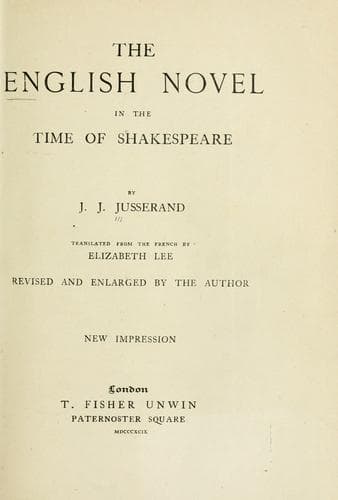
The English Novel in the Time of ShakespeareJusserand, J. J. (Jean Jules)
History
The English Novel in the Time of Shakespeare
Jusserand, J. J. (Jean Jules)
English fiction -- Early modern, 1500-1700 -- History and criticism
In this age obviously Racine could not please. Nor would Shakespeare
have pleased a French audience, but as we know no attempt in that
direction was made in Paris. The two nations lent one another, if
anything, their defects. "Alaric" was named with praise by Dryden;
Scudery and La Calprenede continued to be most popular French authors
during the century. Even in the next we find something remaining of
their fame. Among the books in the library of the fashionable Leonora,
Addison notices: "'Cassandra,' 'Cleopatra,' 'Astraea' ... the 'Grand
Cyrus,' with a pin stuck in one of the middle leaves ... 'Clelia,' which
opened of it self in the place that describes two lovers in a
bower,"[351] &c. The passions in them which seem to us now so incredibly
frigid, had not yet cooled down; their warmth was still felt: so much so
that in one of Farquhar's plays, "Cassandra" is mentioned as greatly
responsible for Lady Lurewell's first and greatest fault, the beginning
of many others: "After supper I went to my chamber and read 'Cassandra,'
then went to bed and dreamt of it all night, rose in the morning and
made verses ..."[352] We cannot follow her in her account of the
consequences.
All that was truly noble and simple in French literature was known, but
at the same time generally misunderstood in England. To make French
authors acceptable, grossness was added to Moliere, bombast to Racine;
even Otway, when translating "Berenice," transformed Racine's "Titus"
into a bully of romance who, in order to assuage his grief, goes to
overrun "the Universe" and make "the worlds" as wretched as he is.[353]
Madame de la Fayette had shown how it was possible to copy from life, in
a novel, true heroism and true tenderness without exaggeration; her
exquisite masterpiece was translated of course as was everything then
that was French; but oblivion soon gathered round the "Princess of
Cleve," and the only proof we have that it did not pass unnoticed is a
clumsy play by Lee, in which this best of old French novels is
mercilessly caricatured.[354] There was no attempt to imitate the
Comtesse's pure and perfect style and high train of thought.
IV.
Public-domain text, read in full here on John Shaqi.
Reviews
Reviews
No reviews yet
Be the first to share your thoughts on this work.
Elsewhere in the archive
Join the Discussion
Join the discussion
Sign in to leave a comment or review.
Sign InorCreate an account