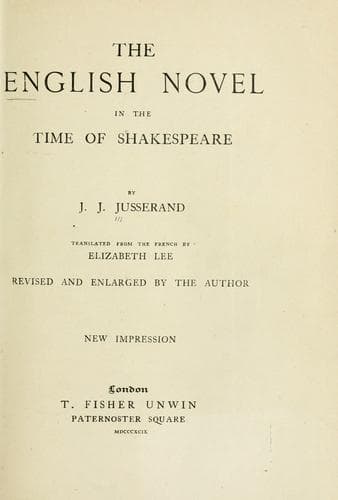
The English Novel in the Time of ShakespeareJusserand, J. J. (Jean Jules)
History
The English Novel in the Time of Shakespeare
Jusserand, J. J. (Jean Jules)
English fiction -- Early modern, 1500-1700 -- History and criticism
Reaction against the heroical romances did not wait, however, till the
eighteenth century to assert itself in England; it set in early and very
amusingly: but it remained powerless. As the evil had chiefly come from
France, so did the remedy; but the remedy in France proved sufficient
for a cure. In that country at all times the tale had flourished, and at
all times in the tale, to the detriment of chivalry and heroism, writers
had prided themselves on seeking mere truth. Thus, in the charming
preface of the Reine de Navarre's "Heptameron," Dame Parlamente
establishes the theory of these narratives, and relates how, at the
court, it had been decided to write a series of them, but to exclude
from the number of their authors "those who should have studied and be
men of letters; for Monseigneur the Dauphin did not wish their artifice
to be introduced into them, and was also afraid lest the beauty of
rhetoric should in some place injure the truth of the tale."
In the seventeenth century, the tradition of the old story-tellers is
carried on in France in more developed writings, in actual novels, such
as the "Baron de Foeneste" of D'Aubigne, 1617; the "Francion" of Charles
Sorel, 1622(?); the "Berger extravagant" of the same, 1628; the "Roman
Comique" of Scarron, 1651; the "Roman bourgeois" of Furetiere, 1666, and
many others. Scarron, who had travestied Virgil, was not the man to
spare La Calprenede, and he does not lose his opportunity. "I cannot
exactly tell you," he writes of one of his characters, "whether he had
sup'd that night, or went to bed empty, as some Romance-mongers use to
do, who regulate all their heroes' actions, making them rise early, and
tell on their story till dinner time, then dine lightly, and after their
meal proceed in the discourse: or else retire to some shady grove to
talk by themselves, unless they have something to discover to the rocks
and trees."
Furetiere, writing in the same spirit, declares that he wishes to
concern himself with "persons who are neither heroes nor heroines, who
will neither raise armies nor overturn kingdoms; but who will be good
people of middling rank who quietly go on their usual way, of whom some
are handsome and others plain, some wise and others foolish; and the
latter have the appearance indeed of forming the greatest number."[355]
Public-domain text, read in full here on John Shaqi.
Reviews
Reviews
No reviews yet
Be the first to share your thoughts on this work.
Elsewhere in the archive
Join the Discussion
Join the discussion
Sign in to leave a comment or review.
Sign InorCreate an account