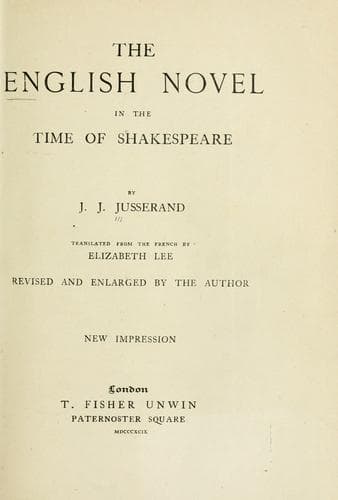
The English Novel in the Time of ShakespeareJusserand, J. J. (Jean Jules)
History
The English Novel in the Time of Shakespeare
Jusserand, J. J. (Jean Jules)
English fiction -- Early modern, 1500-1700 -- History and criticism
Without speaking of the more important works of Cervantes and
Rabelais,[356] most of these novels were translated into English, and in
the same spirit as they had been written, that is, to be used as engines
of war against heroes and heroism. "The French themselves," writes one
of the translators, "our first romantique masters ... have given over
making the world otherwise than it was; are now come to represent it to
us as it is and ever will be."[357] "Among all the books that ever were
thought on," writes another, who curiously enough had about the same
opinion of the favourite novels of his time as Sidney had had of the
drama a century earlier, "those of knight errantry and shepherdry have
been so excellently trivial and naughty, that it would amuse a good
judgment to consider into what strange and vast absurdities some
imaginations have straggled ... the Knight constantly killing the gyant,
or it may be whole squadrons; the Damosel certainly to be relieved just
upon the point of ravishing; a little childe carried away out of his
cradle after some twenty years discovered to be the sone of some great
prince; a girl after seven years wandring and co-habiting and being
stole, confirmed to be a virgin, either by a panterh, fire or a
fountain, and lastly all ending in marriage ... These are the noble
entertainments of books of this kinde, which how profitable they are,
you may judge; how pernicious 'tis easily seen, if they meet but with
an intentive melancholy and a spirit apt to be overborn by such
follies;"[358] a spirit, in fact, such as Lady Lurewell's, whose reading
of "Cassandra" had, as we have seen, such remarkable consequences.[359]
[Illustration: A POET'S DREAM REALIZED, FROM "THE EXTRAVAGANT SHEPHERD,"
1653.]
Efforts made in England to imitate this style and to lead, by means of
the romance itself, a reaction against the false heroism that the
romance had introduced, proved sadly abortive. These attempts have
fallen into a still more profound oblivion than those of the
story-tellers of Shakespeare's time. The English were not yet masters of
the supple, crisp and animated language which suited that kind of tale,
and which the French possessed from the thirteenth century. A few
original minds like Sidney in his "Apologie" had employed it; but they
formed rare exceptions, and in the seventeenth century most men
continued to like either the pompous prose with its Latin periods, held
in highest honour by Bacon, or the various kinds of flowery prose used
by Lodge, Greene, Shakespeare and Sidney. So the romance writers who
attempted to bring about a reaction received no encouragement and were
forgotten less from want of merit than because even their
contemporaries paid no attention to them. Thinking to open up a new
path, they got entangled in a blind alley where they were left. The
ground was to be broken anew by more robust hands than theirs, the hands
of Defoe.
Public-domain text, read in full here on John Shaqi.
Reviews
Reviews
No reviews yet
Be the first to share your thoughts on this work.
Elsewhere in the archive
Join the Discussion
Join the discussion
Sign in to leave a comment or review.
Sign InorCreate an account