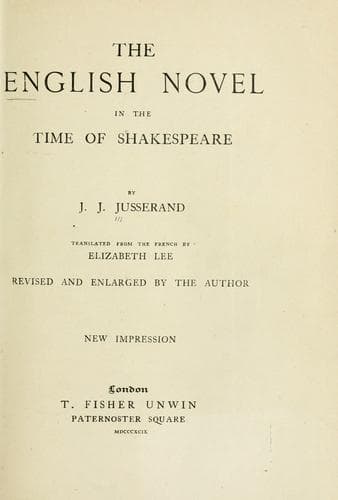
The English Novel in the Time of Shakespeare — John Shaqi
The English Novel in the Time of ShakespeareJusserand, J. J. (Jean Jules)
History
The English Novel in the Time of Shakespeare
Jusserand, J. J. (Jean Jules)
English fiction -- Early modern, 1500-1700 -- History and criticism
The fact is the stranger if we remember that Chaucer's popularity never
flagged. It was at its height in the fifteenth and sixteenth centuries;
in the following period the kings of literature, Dryden and Pope, did
homage to him. His works had been amongst the first to be printed.
Caxton's original edition was quickly followed by a second.[13] The
latter was adorned with illustrations, and this rapid publication of a
second and amended text testifies to the great reverence in which the
author was held. Nevertheless it is the fact that Chaucer stands alone;
authors of prose novels who wrote nearly two centuries after his time,
instead of trying to follow in his footsteps, sought their models either
in the old epic literature or in French and Italian story-books. This is
exactly what Chaucer had done himself; but they did it with very
different success, and entirely missed the benefits of the great advance
made by him. By another strange caprice of fate it was these
sixteenth-century writers, and not Chaucer, who were to be the ancestors
of the world-famous novelists of a later age, of the Richardsons and
Fieldings of the eighteenth century.
In one thing, then, the French conquerors entirely failed; they never
succeeded in acclimatizing during the Middle Ages those shorter prose
stories which were so popular in their own country, in which they
themselves delighted and of which charming and sometimes exquisite
models have come to us from the twelfth century downwards. When this art
so thoroughly French began, as we shall see, to be cultivated in
England, it was the outcome of the Renaissance, not of the Conquest.
Hundreds of volumes of mediaeval English manuscripts preserve plenty of
sermons, theological treatises, epic-romances, poems of all sorts; but
the student will not discover one single original prose story to set by
the side of the many examples extant in French literature; nothing
resembling the French stories of the thirteenth century, so delightful
in their frank language, their brisk style and simple grace, in which we
find a foretaste of the prose of Le Sage and Voltaire; nothing to be
compared, even at a distance, in the following century, with the
narratives of Froissart, who, it is true, applied to history his genius
for pure romance; nothing like the anecdotes so well told by the Knight
of La Tour Landry for the instruction of his daughters; nothing that at
all approaches "Petit Jehan de Saintre" or the "Cent nouvelles" in the
fifteenth century. To find English prose tales of the Middle Ages we
should be forced to look through the religious manuscripts where they
figure under the guise of examples for the reader's edification. A very
troublesome search it is, but not always a vain one; some of these
stories deserve to be included among the most memorable legends of the
Middle Ages. To give an idea of them I will quote the story of a scholar
of Paris, after Caesarius, but told in far better style by the holy
Public-domain text, read in full here on John Shaqi.
Reviews
Reviews
No reviews yet
Be the first to share your thoughts on this work.
Join the Discussion
Join the discussion
Sign in to leave a comment or review.
Sign InorCreate an account