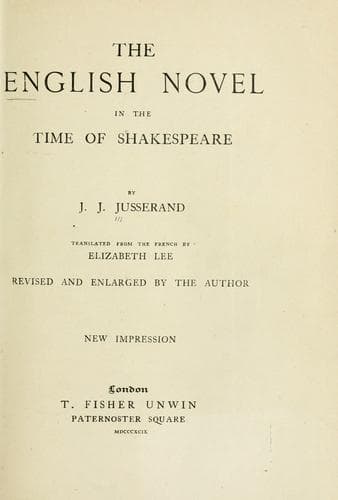
The English Novel in the Time of ShakespeareJusserand, J. J. (Jean Jules)
History
The English Novel in the Time of Shakespeare
Jusserand, J. J. (Jean Jules)
English fiction -- Early modern, 1500-1700 -- History and criticism
Why, among so many famous works, should this publication have obtained
the preference and the attention of the printer? Caxton states his
reasons very clearly: firstly, for him as for Layamon, Arthur is a
national hero, and Englishmen should be proud of him: then again he is
one of the nine worthies of the world. These nine dignitaries were, as
is well known, three pagans, Hector, Alexander and Caesar; three Jews,
Joshua, David and Judas Maccabaeus; three Christians, Arthur, Charlemagne
and Godfrey of Bouillon. And lastly, Caxton considered his undertaking
justified by the great lessons that were to be drawn from Arthur's
example: "And I accordyng to my copye have doon sette it in enprynte to
the entente that noble men may see & lerne the noble actes chyvalrye the
jentyl & vertuous dedes that somme knyghtes used in tho dayes by whyche
they came to honour & how they that were vycious were punysshed & ofte
put to shame & rebuke, humbly byseching al noble lordes & ladyes wyth al
other estates of what estate or degree they been of, that shal see &
rede in this sayd book & werke, that they take the good & honest actes
in their remembraunce & to folowe the same. Wherein they shalle fynde
many joyous & playsaunt hystoryes & noble & renomed actes of humanyte
gentylnesse & chyualryes. For herein may be seen noble chyvalrye,
curtosye, humanyte, frendlynesse, hardynesse, love, frendshyp,
cowardyse, murdre, hate, vertue & synne. Doo after the good & leve the
evyl & it shal brynge you to good fame & renommee."[22]
Public-domain text, read in full here on John Shaqi.
Reviews
Reviews
No reviews yet
Be the first to share your thoughts on this work.
Join the Discussion
Join the discussion
Sign in to leave a comment or review.
Sign InorCreate an account