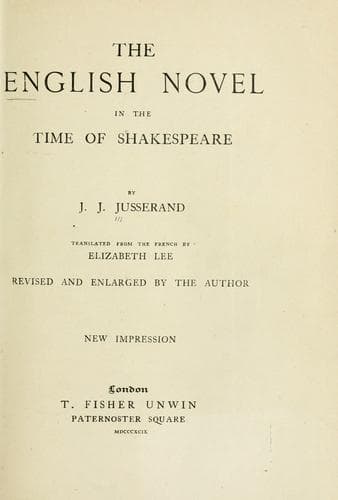
The English Novel in the Time of ShakespeareJusserand, J. J. (Jean Jules)
History
The English Novel in the Time of Shakespeare
Jusserand, J. J. (Jean Jules)
English fiction -- Early modern, 1500-1700 -- History and criticism
Some years before Sir Thomas More wrote his "Utopia," an Englishman, who
had long lived abroad and had there learnt a new industry, unknown in
his own land, returned to England and settled in Westminster. He and his
trade were destined to exercise a very important influence on the
diffusion of literature, and especially on the development of romances.
His art was printing, and his name was Caxton. We can judge of the
amazement he produced among his countrymen by his new art, from his own
wonder; one of his prefaces shows clearly enough how extraordinary his
performance seemed to himself: "And for as moche, says he, as in the
wrytyng of the same my penne is worn, myn hande wery & not stedfast, myn
eyen dimed with overmoche lokyng on the whit paper & my corage not so
prone & redy to laboure as hit hath ben & that age crepeth on me dayly &
febleth all the bodye, & also be cause I have promysid to diverse
gentilmen & to my frendes to addresse to hem as hastely as I myght this
sayd book, therfore I have practysed & lerned at my grete charge &
dispense to ordeyne this said book in prynte after the maner & forme as
ye may here see, & is not wreton with penne & ynke as other bokes ben,
to thende that every man may have them attones, ffor all the bookes of
this storye named the recule of the historyes of troyes thus enpryntid
as ye here see were begonne in oon day & also fynysshid in oon day."[21]
The list of his books shows that he was no less intent upon diverting
his customers than upon improving their knowledge and morals. The part
allotted to fiction was extremely large, not perhaps quite so extensive
as that occupied by the novel proper in the publishers' lists of to-day;
but regarding it as merely a beginning, it must be admitted to be very
promising. Not only did he print the tales of Chaucer, the confessions
of Gower, with their numerous stories, several poems of Lydgate, a
number of mediaeval epic romances in verse, but he also issued from his
press the prose story of "Reynard the Fox," which contains so much
excellent dialogue and so many fine scenes of comedy; and, besides, the
most remarkable prose romance that had yet been written in the English
language, the famous "Morte d'Arthur" of Sir Thomas Malory. Its
appearance marks an epoch in the history of English romance literature.
Public-domain text, read in full here on John Shaqi.
Reviews
Reviews
No reviews yet
Be the first to share your thoughts on this work.
Join the Discussion
Join the discussion
Sign in to leave a comment or review.
Sign InorCreate an account