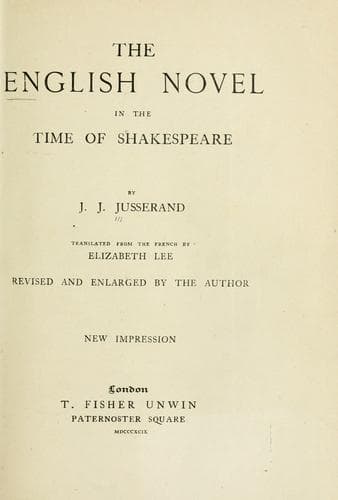
The English Novel in the Time of ShakespeareJusserand, J. J. (Jean Jules)
History
The English Novel in the Time of Shakespeare
Jusserand, J. J. (Jean Jules)
English fiction -- Early modern, 1500-1700 -- History and criticism
Once in the whole length of this immense work he does impart to us his
personal opinion on a question of importance: in the twenty-fifth
chapter of his eighteenth book, Malory confesses what he thinks of love,
and lays aside his usual reserve: and thus furnishes the first attempt
at analysis of feeling to be found in the English prose romance. Malory
declares that every man should love God first and his mistress
afterwards; and so long as a man does love his God first, the other
love seems to him to be not only permissible but even commendable; it is
a virtue. "Therfore, as may moneth floreth & floryssheth in many
gardyns, soo in lyke wyse, lete every man of worship florysshe his herte
in this world, fyrst unto God & next unto the joye of them that he
promysed his feythe unto: for there was never worshypful man or
worshipfull woman but they loved one better than another ... & suche
love, I calle vertuous love." But now-a-days, continues the old knight,
little suspecting that his grievance is one of all ages, men cannot love
seven-night but they must have all their desires. The old love was not
so. Men and women could love together seven years, and no wanton lusts
were between them, and then was love truth and faithfulness. "And loo,"
Malory adds forgetting that his Lancelot and his Tristan waited much
less than seven years, "in lyke wyse was used love in Kynge Arthurs
dayes."[24]
Very strikingly does this view of love contrast with the southern
irrepressible impetuosities of young Aucassin, who, considering, three
centuries earlier, this same question of holy and profane love, of earth
and paradise, in the above-mentioned exquisite prose tale which bears
his name, simply alters the order of precedence afterwards adopted by
good Sir Thomas: "Tell me," says he, "where is the place so high in all
the world that Nicolete, my sweet lady and love, would not grace it
well? If she were Empress of Constantinople or of Germany, or Queen of
France or England, it were little enough for her.... In Paradise what
have I to win? Therein I seek not to enter, but only to have Nicolete my
sweet lady that I love so well.... For in Paradise go none but ... these
same old priests, and halt old men and maimed, who all day and night
cower continually before the altars, and in the crypts.... These be they
that go into Paradise; with them have I naught to make. But into Hell
would I fain go; for into Hell fare the goodly clerks and goodly knights
that fall in tourneys and great wars.... And thither pass the sweet
ladies.... Thither goes the gold and the silver and cloth of vair, and
cloth of gris, and harpers and makers, and the prince of this world.
With these I would gladly go, let me but have with me Nicolete my
sweetest lady."[25]
[Illustration: "NOBLE HELYAS KNYGHTE OF THE SWANNE," ABOUT 1550.]
Public-domain text, read in full here on John Shaqi.
Reviews
Reviews
No reviews yet
Be the first to share your thoughts on this work.
Join the Discussion
Join the discussion
Sign in to leave a comment or review.
Sign InorCreate an account