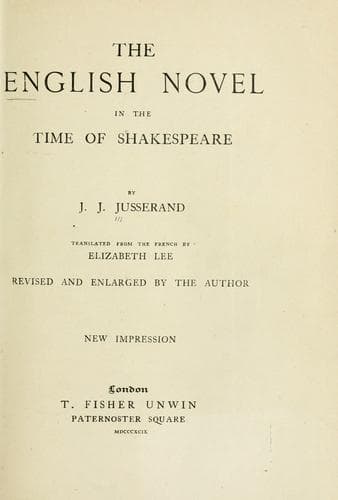
The English Novel in the Time of ShakespeareJusserand, J. J. (Jean Jules)
History
The English Novel in the Time of Shakespeare
Jusserand, J. J. (Jean Jules)
English fiction -- Early modern, 1500-1700 -- History and criticism
No one perceived the coldness of Malory's stories. He wrote for a
youthful and enthusiastic people; it was a period of new birth
throughout Europe, the period of the spring-time of modern literature,
the epoch of the Renaissance. There was no need to depict in realistic
fashion the passions and stirrings of the heart in order to excite the
emotion of the reader; a relation of events sufficed for him; his own
imagination did the rest, and enlivened the dull-painted canvas with
visions of every colour. The book had as much success as Caxton could
have expected; it was constantly reprinted during the sixteenth century,
and enchanted the contemporaries of Surrey, of Elizabeth, and of
Shakespeare. It was in vain that the serious-minded Ascham condemned
it; it survived his condemnation as the popularity of Robin Hood
survived the sermons of Latimer. Vainly did Ascham denounce "Certaine
bookes of Chevalrie.... as one for example, _Morte Arthure_: the whole
pleasure of whiche booke standeth in two speciall poyntes, in open mans
slaughter, & bold bawdrye. In which booke those be counted the noblest
knightes, that do kill most men without any quarell, & commit fowlest
aduoulteres by sutlest shiftes."[26]
When the people became more thoughtful or more exacting in the matter of
analysis, they neglected the old book. After 1634, two hundred years
passed without a reprint of it. In our time it has met with an aftermath
of success, not only among the curious, but among a class of readers who
are not more exacting than Caxton's clients, and who are far more
interested in fact than in feeling. Children form this class of readers;
in the present century Malory's book has been many times re-edited for
them, and it is to Sir Thomas Malory, rather than to Tennyson, Swinburne
or Morris, that many English men and women of to-day owe their earliest
acquaintance with King Arthur and his Knights.
Public-domain text, read in full here on John Shaqi.
Reviews
Reviews
No reviews yet
Be the first to share your thoughts on this work.
Join the Discussion
Join the discussion
Sign in to leave a comment or review.
Sign InorCreate an account