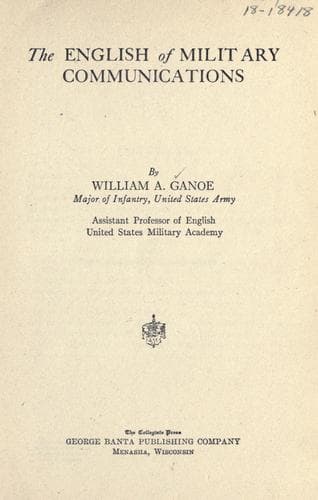
The English of military communicationsGanoe, William Addleman
History
The English of military communications
Ganoe, William Addleman
English language -- Rhetoric; Military orders; United States. Army -- Records and correspondence
Where “stamp” appears in parenthesis, the word does not actually
occur in letters. It indicates that the office which received the
letter noted by means of a rubber stamp at that particular place
on the letter the date on which the communication was received or
received back. In other words, what follows “(Stamp)” was placed
there by some one of the office force as soon as the letter was
received in that office.
The writing on all pages should begin one inch from the top. The
pages, beginning with the first will be numbered serially. The
number will be placed half way between the edges and one inch above
the bottom of the page. In referring to an indorsement by number, the
number of the page will also be given, thus: “5th Ind., page 3.”
All ceremonial forms at the beginning and end of letters such
as “Sir,” “I have the honor,” “I would respectfully,” “Very
respectfully” and the like will be omitted. In referring,
transmitting, forwarding, and returning papers, the expressions
“Respectfully referred,” “Respectfully transmitted,” “Respectfully
forwarded,” and “Respectfully returned,” will also be omitted.
“An officer will not be designated in orders nor addressed in
official communications by any other title than that of his actual
rank.”[22] Wherever appropriate the name should be supplanted by the
title, such as “Commanding Officer, Co. A, 99th Infantry” in place of
“Captain James L. Douglas.”
“All letters and indorsements which are typewritten, excepting
letters of transmittal, reports of taking leave of absence,
periodical reports, and communications of a similar nature, will
be made with two carbon copies. One copy will be retained for the
records of the office in which the letter was written, and the other
will be forwarded with the communication for the files of the first
office in which a complete copy is required for the records, but such
copy will not be regarded as an enclosure. It will be initialed by
the person responsible for the communication.”
“In official correspondence between officers or between officers
and officials of other branches of the public service, and
especially in matters involving questions of jurisdiction, conflict
of authority, or dispute, officers of the Army are reminded that
their correspondence should be courteous in tone and free from any
expression partaking of a personal nature or calculated to give
offense. Whenever questions of such character shall arise between
officers and officials of other branches of the public service,
and it is found that they cannot be reconciled by an interchange
of courteous correspondence, the officer of the Army, as the
representative of the interests of the War Department in the matter
involved, will make a full presentation of the case to the Secretary
of War through the proper military channels, in order that the same
may be properly considered.
Public-domain text, read in full here on John Shaqi.
Reviews
Reviews
No reviews yet
Be the first to share your thoughts on this work.
Elsewhere in the archive
Join the Discussion
Join the discussion
Sign in to leave a comment or review.
Sign InorCreate an account