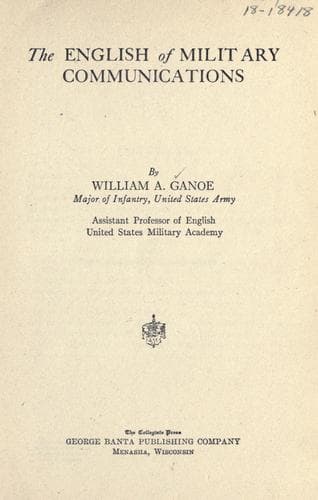
The English of military communicationsGanoe, William Addleman
History
The English of military communications
Ganoe, William Addleman
English language -- Rhetoric; Military orders; United States. Army -- Records and correspondence
In order to reduce the possibility of confidential communications
falling into the hands of persons other than those for whom they
are intended, the sender will enclose them in an inner and outer
cover; the inner cover to be a sealed envelope or wrapper addressed
in the usual way, but marked plainly “Confidential” in such a manner
that the notation may be most readily seen when the outer cover is
removed. The package thus prepared will then be enclosed in another
sealed envelope or wrapper addressed in the ordinary manner with no
notation to indicate the confidential nature of the contents.
The foregoing applies not only to confidential communications
entrusted to the mails or to telegraph companies, but also to such
communications entrusted to messengers passing between different
offices of the same headquarters, including the bureaus and offices
of the War Department.”
We have so far discussed in this chapter official letters to persons
in the military service. We now come to consider the second form of
official letter—the one to persons outside the military service.
Often an adjutant or quartermaster is called upon to write to
individuals or firms not conversant with the military forms. For a
variety of reasons, the business form in that case is best.
In general the two forms present the following differences and
likenesses. The headings are the same. The business form substitutes
the _Address_ of the _Recipient_ and the _Salutation_ for the _From
Whom Sent_, _To Whom Sent_, and _Subject_ of the military form. The
_Body_ in each case follows the principles of paragraphing, and unity
and coherence of the whole, as set down for the military form. In
the business form the paragraphs need not be numbered. The business
form has a complimentary close before the signature, rank, and
organization of the writer. Letters are retained by the recipient
and answered by him with a new letter, the sender retaining a carbon
copy. Indorsements are not used in the business form.
An example of a good business form appears below.
Office of the Quartermaster,
West Point, N. Y.,
August 7, 1930.
Messrs. D. C. Johnson and Company,
312 High Street,
Boston, Massachusetts.
Gentlemen:
In reference to your letter of the 5th inst., I desire to inform
you that there is no need here at present for the roofing mentioned.
I regret that we cannot at this time become customers of your firm,
but we shall hold you in mind when the necessity for roofing arises.
Yours very truly,
J. H. Smith,
Major, Q. M. Corps, U. S. A.
Quartermaster.
The entire _address_ of the recipient had best be written before the
_salutation_.
Public-domain text, read in full here on John Shaqi.
Reviews
Reviews
No reviews yet
Be the first to share your thoughts on this work.
Elsewhere in the archive
Join the Discussion
Join the discussion
Sign in to leave a comment or review.
Sign InorCreate an account