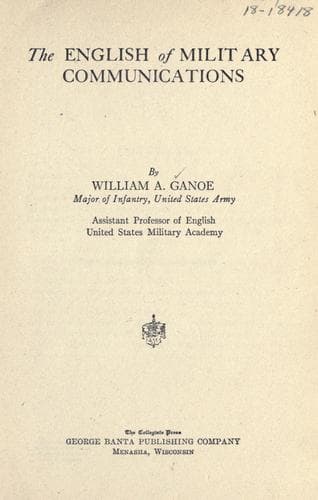
The English of military communicationsGanoe, William Addleman
History
The English of military communications
Ganoe, William Addleman
English language -- Rhetoric; Military orders; United States. Army -- Records and correspondence
Other proper _salutations_ are:
My dear Sir:
My dear Madam:
Ladies:
Other proper _Complimentary Closings_ are:
Yours truly,
Yours respectfully,
Stick close to the forms of the model above. A very slight departure
will make you appear crude. For instance, to say
D. C. Johnson,
Boston, Mass.
Messrs.—
would be entirely wrong.
As to the _Body_ of the letter, however, write it your own way so
long as you use words, phrases, clauses, sentences, and paragraphs,
of a kind we have striven to attain throughout this work. Do not make
your letter telegraphic; complete your sentences.
The instructions given for the attainment of the proper forms in
ordinary business communications are in no sense as rigid as those
given for the military communication. Many officers now use the
military forms for their correspondence with business firms, and,
indeed, many of these firms have themselves adopted the military form.
The third type of official letter is that of the official telegram.
It does not differ in principle from the ordinary telegram, and
therefore does not require separate practice. Those who have
conquered the field message should have no trouble in its composition.
It is written on an official telegraph blank which may be obtained
from the Quartermaster. The blank is for the purpose of having
the message go at Government expense. Army Regulations state that
“telegrams will be followed by official copies sent by the first
mail in cases of financial transactions of more than trifling
importance, and in cases in which chiefs of bureaus of the War
Department may deem it necessary themselves to send, or to require
officers serving under their immediate control to send them, such
copies.” It is a good thing in any case to mail a copy of a telegram.
The other kinds of official correspondence which need no letters to
accompany them are _Rolls_, _Returns_, _Estimates_, _Requisitions_,
and _Routine Reports_. A study of these forms of communication
belongs properly to the subject of administration. They are,
therefore, simply mentioned here.
The principal Rolls with which the novice in the military service is
confronted are the _Muster_ and _Pay Rolls_. The former is rendered
every two months and the latter every month.[23] Full instructions as
to what is required in each set of rolls are found on the last page
of each form. On application to the Adjutant General of the Army, a
list of _model remarks_ for the rolls will be furnished.
The principal _Returns_ with which the novice should become familiar
are the _Ration_, _Clothing_, _Ordnance_, _Company_ (monthly), and
_Field_ Returns.
_Estimates_ and _Requisitions_ are used most frequently by the Supply
Departments. But organizations must prepare _Estimates_ of what they
will need, and must prepare _Requisitions_ for the desired articles
when needed. The _Clothing Estimate_ and _Clothing Requisition_ are
two common and important forms.
Public-domain text, read in full here on John Shaqi.
Reviews
Reviews
No reviews yet
Be the first to share your thoughts on this work.
Elsewhere in the archive
Join the Discussion
Join the discussion
Sign in to leave a comment or review.
Sign InorCreate an account