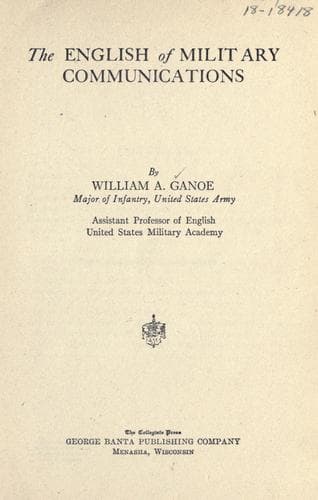
The English of military communicationsGanoe, William Addleman
History
The English of military communications
Ganoe, William Addleman
English language -- Rhetoric; Military orders; United States. Army -- Records and correspondence
1. _Write legibly._—Rain, wear in the pocket, dim and fading lights,
and crumpled paper are going to make havoc of your orders and
messages in war time. Your commanding officer must be able to make
out your script as well as your meaning. Now is the moment to make
your handwriting a size or two larger and noticeably plainer.
2. _Inspect the form._ After you have written your ideas legibly,
_look at them searchingly to see that they mean only what you intend_.
You cannot be too cold-blooded about this act for two reasons.
In the first place, there is a habit which is strong upon us. We
have all been too prone to state a thing haphazardly, and then to
exclaim, “You know what I mean!” The person addressed, of course, is
not going to acknowledge that he has not the brains to understand; so
the jumble is never smoothed out. Thus in nine-tenths of our off-hand
moments we have been accustomed to say what we do _not_ mean. The
habit is so strong that when we find ourselves dealing with matters
of life and death, we are still liable to whisper to ourselves,
“O, well, he’ll get it.” The result is that the part of the order,
message, or report, which struck us as having our usual clearness,
is a puzzle to the recipient.
In the second place, the impression has grown up in the minds of many
that substance, no matter how it is mixed, is all that is necessary.
There has come about a certain proud disregard of the _manner_ in
which a thing is expressed. Too many technical books have failed of
their purpose because the writer, although he was an expert in his
line, did not know how to present his subject in an attractive form.
In the same way explanations have failed upon the drill ground, and
lectures have made excellent tacticians appear like school-boys. The
very manner of communication has not only spoiled the taste for the
subject matter but has hindered its absorption. His audience has not
understood his explanation.
In inspecting your work, take the attitude that the recipient is
skeptical of everything you have said.
* * * * *
It is assumed that you wish to fasten in your mind everything in this
chapter. The following method is suggested as the best short-cut:
1. Make an outline of the whole chapter, expressing the main idea of
each paragraph and sub-paragraph in two or three words.
2. Close your books.
3. With the aid of your outline see whether you can call to your mind
everything the paragraph or sub-paragraph means.
CHAPTER II
MILITARY COMMUNICATIONS
The following are the various types of military communication:
FIELD MESSAGES convey verbal or written information by messenger or
wire.
REPORTS are written accounts of some enterprise, undertaking, or
event, such as a reconnaissance, march, or battle.
WAR DIARIES are daily records of events kept during campaign by each
battalion and higher organization. From the entries in these diaries
the facts of our military history are obtained.
Public-domain text, read in full here on John Shaqi.
Reviews
Reviews
No reviews yet
Be the first to share your thoughts on this work.
Join the Discussion
Join the discussion
Sign in to leave a comment or review.
Sign InorCreate an account