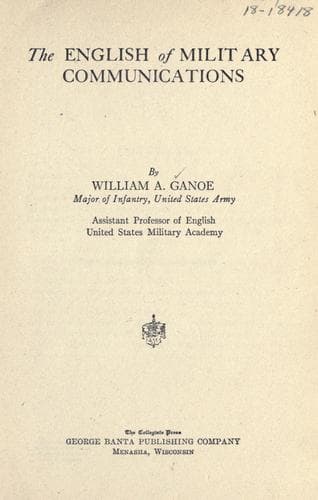
The English of military communicationsGanoe, William Addleman
History
The English of military communications
Ganoe, William Addleman
English language -- Rhetoric; Military orders; United States. Army -- Records and correspondence
6. In the newspaper or book that you are reading, every time you meet
a new word make it yours. Look up the meaning in the dictionary until
you are sure that you know how to use the word.
At the first opportunity, employ it in your conversation or writing.
Sooner or later “dope” and the eternal “damn” will have ceased to
fill in endless crevices in your talk and their places will have
been taken by incisive words. You will awake to find that you are
expressing yourself more easily and plainly. On the other hand, every
word you pass over or for which you merely consult the dictionary,
is a tool cast aside in your building of an officer. Every bit of
slang or profanity which now crowds out the appropriate word will
later rise up and clog your thought at a time when you are making
your utmost endeavor to put into clear, forceful English your plan of
action or your order.
AS TO PHRASES AND CLAUSES.
Remember to place phrases and clauses nearest the words they modify.
Captain George will divide the tools equally among the battalions
_which are fit for felling timber_.
The change of the italicized clause to its proper position next the
word _tools_, gives the intended meaning.
AS TO SENTENCES.
1. Use the short complex sentence; such as:—
An attack is expected tomorrow from strong hostile forces whose
advanced troops are near FORT MONTGOMERY.
The enemy’s infantry disappeared to the south as soon as our
advance cavalry came over the hill.
The use of _when_, _since_, _because_, _where_, _whenever_,
_although_, _after_, _till_, _until_, _as_, _so long as_, _now
that_, _whence_, _whither_, _inasmuch as_, _that_, _in order that_,
_so that_, and _lest_, with the finite form of the verb is a good
construction to practice.
Notice how compact and explicit is the following:—
Lest the enemy should turn your flank, keep veering to the east.
Try to put this same thought into twelve words by means of a
different construction.
2. When you start with one kind of construction, keep it up unless
there be some good reason to change it. If you begin with the past
tense and third person, have the past tense and third person continue
throughout the sentence or sentences.
It is reported that extensive preparations are being made in the
vicinity of CAMBRAI and the enemy has stored railroad material
there.
It is reported that the enemy has made extensive preparations at
CAMBRAI and has stored railroad material there.
Which sentence reads along with less break?
Again,
It is advisable to advance part of the ammunition columns and that
the division should follow at 200 yards.
Better,
It is advisable to advance part of the ammunition columns and to
have the division follow at 200 yards.
Now that specific guides have been posted near the grammatical turns
of the road, let us look at two general rules covering everything we
do.
Public-domain text, read in full here on John Shaqi.
Reviews
Reviews
No reviews yet
Be the first to share your thoughts on this work.
Join the Discussion
Join the discussion
Sign in to leave a comment or review.
Sign InorCreate an account